鼎 (dǐng) means "tripod (ancient cooking vessel); cauldron" in Chinese. It has 12 strokes with the radical 鼎, and is HSK Level 7.
Rated 3.9/5 in difficulty (challenging).
Harder than 38% of HSK Level 7 characters.
Appears in 3+ common words including 鼎力 (dǐng lì), 鼎盛 (dǐng shèng), 问鼎 (wèn dǐng).
Due to its 12 strokes, Hanzi Writer's error detection shows 鼎 requires focused practice — most learners need 10+ attempts for consistent accuracy.
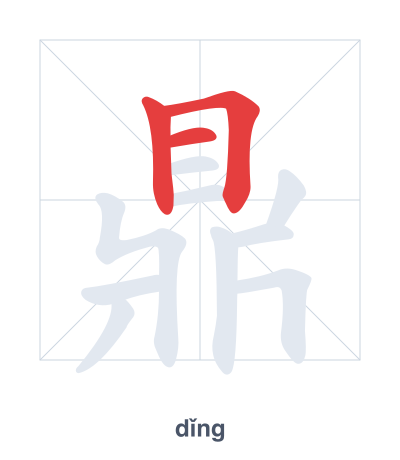
Open Hanzi Writer to see the animated stroke order and practice writing 鼎 with real-time feedback.
The character 鼎 (dǐng) is written with 12 strokes. Follow the standard Chinese stroke order: top to bottom, left to right, outside before inside. The radical 鼎 is one of its key components.
Practice the correct stroke order with the Hanzi Writer app to see animated stroke-by-stroke guidance with real-time feedback.
鼎 means tripod (ancient cooking vessel); cauldron.
As an HSK Level 7 character, 鼎 is an intermediate-level character.
This character is a pictograph of an ancient bronze tripod used for cooking. Its oracle bone script depicted a vessel with two handles on the top and three legs below, and the modern form still conveys this basic shape. The top part suggests the opening or lid, while the bottom lines indicate the tripod's supporting legs.
💡 Memory Tip: Picture the character as a stout three-legged cauldron: the square top is the pot, and the three strokes at the bottom are its sturdy legs.
谢谢你的鼎力相助。
xiè xiè nǐ de dǐng lì xiāng zhù
Thank you for your tremendous help.
这是唐朝鼎盛时期。
zhè shì táng cháo dǐng shèng shí qī
This was the peak of the Tang Dynasty.
他想问鼎冠军。
tā xiǎng wèn dǐng guàn jūn
He wants to compete for the championship.
Open Hanzi Writer to see the animated stroke order and practice writing 鼎 with real-time feedback.
✨ Animated stroke order · Handwriting recognition · HSK-graded practice · Free to use
鼎 is a pictograph that directly depicts an ancient tripod vessel with two handles and three legs. It does not break down into smaller meaningful components; instead, the entire character visually represents the shape of a bronze cauldron used for cooking or ritual offerings.