笏 (hù) means "Official tablet (held at court)" in Chinese. It has 10 strokes with the radical 竹.
Rated 4.2/5 in difficulty (advanced).
Appears in 3+ common words including 象笏 (xiàng hù), 玉笏 (yù hù), 执笏 (zhí hù).
Due to its 10 strokes, Hanzi Writer's error detection shows 笏 requires focused practice — most learners need 10+ attempts for consistent accuracy.
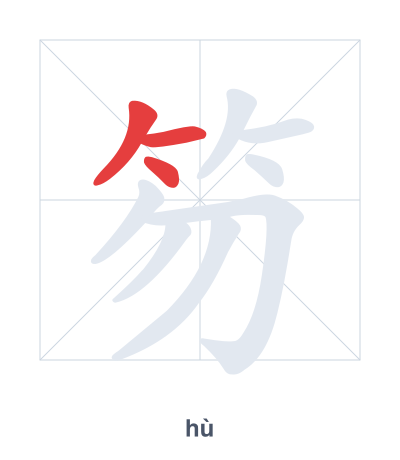
Open Hanzi Writer to see the animated stroke order and practice writing 笏 with real-time feedback.
The character 笏 (hù) is written with 10 strokes. Follow the standard Chinese stroke order: top to bottom, left to right, outside before inside. The radical 竹 is one of its key components.
Practice the correct stroke order with the Hanzi Writer app to see animated stroke-by-stroke guidance with real-time feedback.
笏 means Official tablet (held at court).
笏 is a compound character with the radical 竹 (bamboo) indicating the material—early official tablets were often made of bamboo. The phonetic component 勿 (hù) provides the sound, though its literal meaning 'do not' is incidental. The character visually represents a bamboo strip held by court officials for recording imperial decrees.
💡 Memory Tip: Don't (勿) let your bamboo (竹) tablet slip from your hands during the emperor's audience—that's your 笏!
他手里拿着象笏。
tā shǒu lǐ ná zhe xiàng hù
He is holding an ivory tablet in his hand.
玉笏非常珍贵。
yù hù fēi cháng zhēn guì
The jade tablet is very precious.
大臣正在执笏。
dà chén zhèng zài zhí hù
The minister is holding a ceremonial tablet.
Open Hanzi Writer to see the animated stroke order and practice writing 笏 with real-time feedback.
✨ Animated stroke order · Handwriting recognition · HSK-graded practice · Free to use
The character 笏 combines the radical 竹 (bamboo) on top, indicating that the tablet was originally made from bamboo, and the phonetic component 勿 (wù) below. Together, they form a character that refers to a flat, narrow tablet held by officials during ancient court ceremonies.