附 (fù) means "to attach / to be near" in Chinese. It has 7 strokes with the radical 阝, and is HSK Level 4.
Rated 3.2/5 in difficulty (challenging).
Harder than 24% of HSK Level 4 characters.
Appears in 3+ common words including 附近 (fù jìn), 附件 (fù jiàn), 附属 (fù shǔ).
Due to its 7 strokes, Hanzi Writer's error detection shows 附 requires focused practice — most learners need 10+ attempts for consistent accuracy.
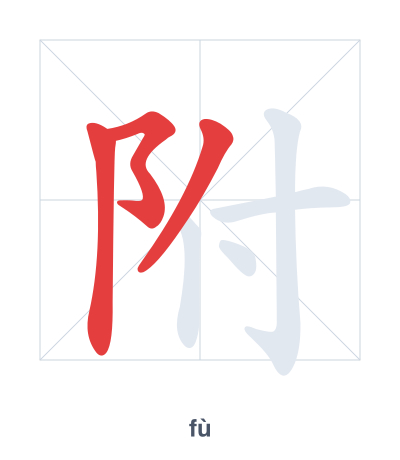
Open Hanzi Writer to see the animated stroke order and practice writing 附 with real-time feedback.
The character 附 (fù) is written with 7 strokes. Follow the standard Chinese stroke order: top to bottom, left to right, outside before inside. The radical 阝 is one of its key components.
Practice the correct stroke order with the Hanzi Writer app to see animated stroke-by-stroke guidance with real-time feedback.
附 means to attach / to be near.
As an HSK Level 4 character, 附 is an intermediate-level character.
附 combines the radical 阝 (a variant of 阜, meaning a mound or hill) with 付 (fù, meaning 'to give' or 'hand over'). The mound suggests a place or location, while 付 adds the idea of delivering or adding something to that spot, together conveying the sense of attaching or being near.
💡 Memory Tip: Picture a person (亻) using a hand (寸) to stick a letter (for attachment) onto the side of a hill (阝).
我家就在附近。
wǒ jiā jiù zài fù jìn
My home is nearby.
请查收邮件附件。
qǐng chá shōu yóu jiàn fù jiàn
Please check the email attachment.
这是附属医院。
zhè shì fù shǔ yī yuàn
This is an affiliated hospital.
Open Hanzi Writer to see the animated stroke order and practice writing 附 with real-time feedback.
✨ Animated stroke order · Handwriting recognition · HSK-graded practice · Free to use
The character 附 is made of the left radical 阝 (meaning 'hill' or 'mound') and the right part 付 (meaning 'to give' or 'to pay'). Together they suggest something placed next to or attached to a hill, which connects to the character's meanings of 'to attach' or 'to be near.'