浮 (fú) means "to float / to drift" in Chinese. It has 10 strokes with the radical 氵, and is HSK Level 6.
Rated 4.2/5 in difficulty (advanced).
Harder than 73% of HSK Level 6 characters.
Appears in 3+ common words including 漂浮 (piāo fú), 浮现 (fú xiàn), 浮力 (fú lì).
Due to its 10 strokes, Hanzi Writer's error detection shows 浮 requires focused practice — most learners need 10+ attempts for consistent accuracy.
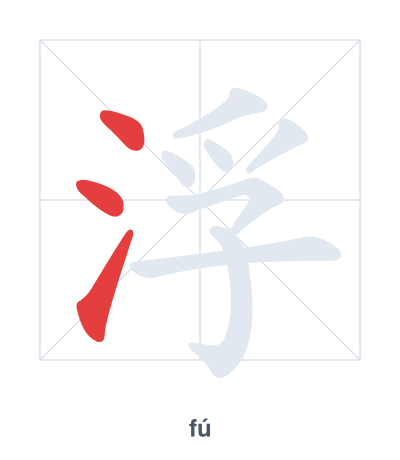
Open Hanzi Writer to see the animated stroke order and practice writing 浮 with real-time feedback.
The character 浮 (fú) is written with 10 strokes. Follow the standard Chinese stroke order: top to bottom, left to right, outside before inside. The radical 氵 is one of its key components.
Practice the correct stroke order with the Hanzi Writer app to see animated stroke-by-stroke guidance with real-time feedback.
浮 means to float / to drift.
As an HSK Level 6 character, 浮 is an intermediate-level character.
浮 is a compound character combining the water radical 氵 and the phonetic component 孚. The 孚 part originally depicted a hand grasping a child, but in 浮 it suggests the idea of floating, as if water is gently supporting something light. Together, they convey the image of something buoyant drifting on water.
💡 Memory Tip: Picture a mother's hand (爫) holding a baby (子) above water (氵) so the baby floats safely.
云在空中漂浮。
yún zài kōng zhōng piāo fú
Clouds are floating in the sky.
脸上浮现出笑容。
liǎn shàng fú xiàn chū xiào róng
A smile appeared on the face.
水有很大的浮力。
shuǐ yǒu hěn dà de fú lì
Water has a lot of buoyancy.
Open Hanzi Writer to see the animated stroke order and practice writing 浮 with real-time feedback.
✨ Animated stroke order · Handwriting recognition · HSK-graded practice · Free to use
The left side is the radical 氵 (water), indicating the character relates to water. The right side is 孚 (fú), which originally meant to grasp or capture but here acts as a phonetic component. Together, water plus the sound 孚 creates the idea of something floating or drifting on water.