锋 (fēng) means "Sharp point; blade edge" in Chinese. It has 12 strokes with the radical 钅, and is HSK Level 6.
Rated 4.2/5 in difficulty (advanced).
Harder than 98% of HSK Level 6 characters.
Appears in 3+ common words including 前锋 (qián fēng), 锋利 (fēng lì), 笔锋 (bǐ fēng).
Due to its 12 strokes, Hanzi Writer's error detection shows 锋 requires focused practice — most learners need 10+ attempts for consistent accuracy.
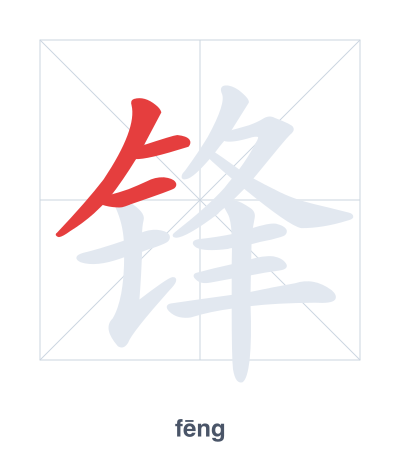
Open Hanzi Writer to see the animated stroke order and practice writing 锋 with real-time feedback.
The character 锋 (fēng) is written with 12 strokes. Follow the standard Chinese stroke order: top to bottom, left to right, outside before inside. The radical 钅 is one of its key components.
Practice the correct stroke order with the Hanzi Writer app to see animated stroke-by-stroke guidance with real-time feedback.
锋 means Sharp point; blade edge.
As an HSK Level 6 character, 锋 is an intermediate-level character.
锋 combines the metal radical 钅 with the phonetic component 夆, which itself suggests a meeting point. The metal radical indicates the material, and together they represent the sharp edge of a blade or tool.
💡 Memory Tip: Imagine a metal (钅) spike so sharp it can split a mountain peak (夆).
他是足球队的前锋。
tā shì zú qiú duì de qián fēng
He is a forward on the soccer team.
这把小刀非常锋利。
zhè bǎ xiǎo dāo fēi cháng fēng lì
This pocket knife is very sharp.
他的笔锋很有力量。
tā de bǐ fēng hěn yǒu lì liàng
His writing style is very powerful.
Open Hanzi Writer to see the animated stroke order and practice writing 锋 with real-time feedback.
✨ Animated stroke order · Handwriting recognition · HSK-graded practice · Free to use
锋 is made of the metal radical 钅 on the left and the phonetic component 夆 on the right. The metal radical connects to the idea of a blade or sharp object, giving the meaning 'sharp point' or 'blade edge'. The right part 夆 provides pronunciation and visually suggests a pointed shape.