凡 (fán) means "ordinary; every; all" in Chinese. It has 3 strokes with the radical 几, and is HSK Level 6.
Rated 2.2/5 in difficulty (moderate).
Harder than 0% of HSK Level 6 characters.
Appears in 3+ common words including 凡是 (fán shì), 平凡 (píng fán), 非凡 (fēi fán).
Hanzi Writer's stroke validation shows learners typically need 5-8 attempts to write 凡 with correct proportion and order.
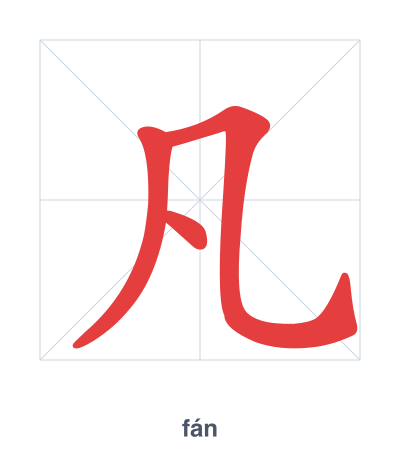
Open Hanzi Writer to see the animated stroke order and practice writing 凡 with real-time feedback.
The character 凡 (fán) is written with 3 strokes. Follow the standard Chinese stroke order: top to bottom, left to right, outside before inside. The radical 几 is one of its key components.
Practice the correct stroke order with the Hanzi Writer app to see animated stroke-by-stroke guidance with real-time feedback.
凡 means ordinary; every; all.
As an HSK Level 6 character, 凡 is an intermediate-level character.
Originally, 凡 was a pictograph of a square vessel or flat board, representing something common and general. Over time, this image of a simple, unadorned container evolved to mean 'ordinary' or 'every.'
💡 Memory Tip: Picture a plain square box (几) with a single dot inside it, as if to say 'nothing special here—just an ordinary item.'
凡是学生都要参加。
fán shì xué shēng dōu yào cān jiā
Every student must participate.
他是一个平凡的人。
tā shì yí gè píng fán de rén
He is an ordinary person.
她的表现非常非凡。
tā de biǎo xiàn fēi cháng fēi fán
Her performance was extraordinary.
Open Hanzi Writer to see the animated stroke order and practice writing 凡 with real-time feedback.
✨ Animated stroke order · Handwriting recognition · HSK-graded practice · Free to use
凡 is composed of the radical 几 (meaning a small table or bench) with a dot (丶) inside. This simple structure suggests something common or everyday, like an ordinary item placed on a table. The dot may represent a generic object, reinforcing the idea of "ordinary" or "every."