凫 (fú) means "Wild duck; teal" in Chinese. It has 6 strokes with the radical 几.
Rated 2.9/5 in difficulty (moderate).
Appears in 3+ common words including 凫水 (fú shuǐ), 凫鸭 (fú yā), 凫鸟 (fú niǎo).
Hanzi Writer's stroke validation shows learners typically need 5-8 attempts to write 凫 with correct proportion and order.
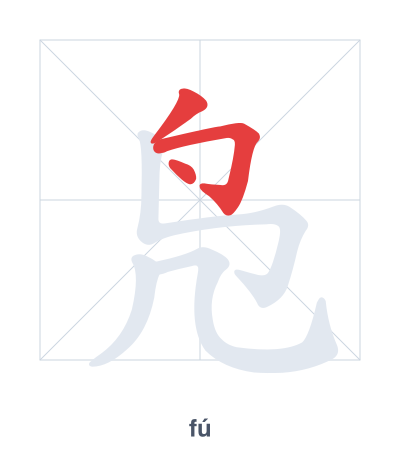
Open Hanzi Writer to see the animated stroke order and practice writing 凫 with real-time feedback.
The character 凫 (fú) is written with 6 strokes. Follow the standard Chinese stroke order: top to bottom, left to right, outside before inside. The radical 几 is one of its key components.
Practice the correct stroke order with the Hanzi Writer app to see animated stroke-by-stroke guidance with real-time feedback.
凫 means Wild duck; teal.
| Character | 凫 |
| Pinyin | fú (fu) |
| Meaning | Wild duck; teal |
| Strokes | 6 |
| Radical | 几 |
| Difficulty | 2.9/5 |
凫 originally depicted a wild duck in ancient script, showing a bird with a short tail. The modern form combines 几 (table, suggesting a resting place) and 鸟 (bird), meaning a duck that often rests on water or land.
💡 Memory Tip: Picture a wild duck (鸟) perched on a small table (几) by the lake, quacking softly.
他在河里凫水。
tā zài hé lǐ fú shuǐ
He is swimming in the river.
湖边有几只凫鸭。
hú biān yǒu jǐ zhī fú yā
There are a few wild ducks by the lake.
凫鸟在水面飞翔。
fú niǎo zài shuǐ miàn fēi xiáng
Wild ducks are flying over the water.
Open Hanzi Writer to see the animated stroke order and practice writing 凫 with real-time feedback.
✨ Animated stroke order · Handwriting recognition · HSK-graded practice · Free to use
凫 is composed of two parts: the top is the radical 几 (small table) and the bottom is 鸟 (bird). Together they suggest a bird, specifically a wild duck, because the 鸟 component directly indicates a bird.