凳 (dèng) means "Stool" in Chinese. It has 14 strokes with the radical 几, and is HSK Level 7.
Rated 3.5/5 in difficulty (challenging).
Harder than 14% of HSK Level 7 characters.
Appears in 3+ common words including 凳子 (dèng zi), 板凳 (bǎn dèng), 长凳 (zhǎng dèng).
Due to its 14 strokes, Hanzi Writer's error detection shows 凳 requires focused practice — most learners need 10+ attempts for consistent accuracy.
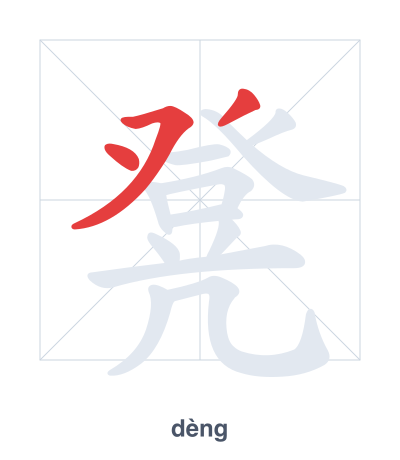
Open Hanzi Writer to see the animated stroke order and practice writing 凳 with real-time feedback.
The character 凳 (dèng) is written with 14 strokes. Follow the standard Chinese stroke order: top to bottom, left to right, outside before inside. The radical 几 is one of its key components.
Practice the correct stroke order with the Hanzi Writer app to see animated stroke-by-stroke guidance with real-time feedback.
凳 means Stool.
As an HSK Level 7 character, 凳 is an intermediate-level character.
凳 combines 登 (dēng, 'to ascend') as a phonetic and semantic hint with 几 (jī, 'small table') as the radical. The idea is a raised platform or stool that helps you climb up or sit upon. Historically, it was originally written 櫈, emphasizing the wooden material.
💡 Memory Tip: Imagine you need to climb (登) onto a tiny table (几) to reach a high shelf, and that table becomes your stool.
请坐在这个凳子上。
qǐng zuò zài zhè ge dèng zi shàng
Please sit on this stool.
这是一个小板凳。
zhè shì yí gè xiǎo bǎn dèng
This is a small wooden stool.
公园里有长凳。
gōng yuán lǐ yǒu zhǎng dèng
There are benches in the park.
Open Hanzi Writer to see the animated stroke order and practice writing 凳 with real-time feedback.
✨ Animated stroke order · Handwriting recognition · HSK-graded practice · Free to use
凳 is made of two parts: 登 on top and 几 on the bottom. 登 originally meant 'to ascend' or 'to step up', and 几 is a small table or stool. Together, they suggest something you step up onto, like a stool.