饵 (ěr) means "bait; pastry" in Chinese. It has 9 strokes with the radical 饣, and is HSK Level 7.
Rated 4/5 in difficulty (challenging).
Harder than 47% of HSK Level 7 characters.
Appears in 3+ common words including 鱼饵 (yú ěr), 诱饵 (yòu ěr), 饵料 (ěr liào).
Due to its 9 strokes, Hanzi Writer's error detection shows 饵 requires focused practice — most learners need 10+ attempts for consistent accuracy.
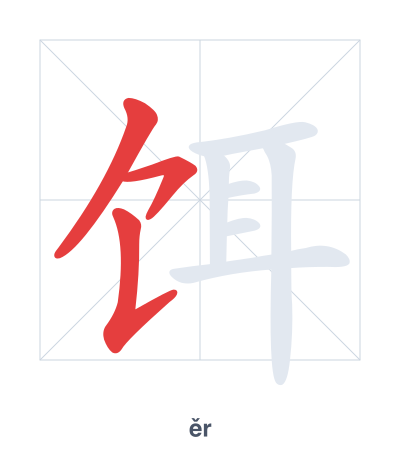
Open Hanzi Writer to see the animated stroke order and practice writing 饵 with real-time feedback.
The character 饵 (ěr) is written with 9 strokes. Follow the standard Chinese stroke order: top to bottom, left to right, outside before inside. The radical 饣 is one of its key components.
Practice the correct stroke order with the Hanzi Writer app to see animated stroke-by-stroke guidance with real-time feedback.
饵 means bait; pastry.
As an HSK Level 7 character, 饵 is an intermediate-level character.
饵 combines the food radical 饣 (shortened form of 食) with 耳 ('ear'), which provides the sound. Originally written as 餌 in traditional form, it depicts food used as bait or a tasty snack, like a pastry.
💡 Memory Tip: Picture a delicious pastry shaped like an ear (耳) made of food (饣) used as bait to catch a fish.
钓鱼需要好鱼饵。
diào yú xū yào hǎo yú ěr
Fishing requires good bait.
这是一个诱饵。
zhè shì yí gè yòu ěr
This is a bait.
这种饵料效果很好。
zhè zhǒng ěr liào xiào guǒ hěn hǎo
This bait works very well.
Open Hanzi Writer to see the animated stroke order and practice writing 饵 with real-time feedback.
✨ Animated stroke order · Handwriting recognition · HSK-graded practice · Free to use
饵 has two parts: the radical 饣 on the left, meaning 'food' or 'eat', and the component 耳 on the right, which provides pronunciation (ěr). Together, 饣 (food) + 耳 (sound) create a character for things you eat or use to attract animals — especially 'bait' or 'pastry'.