遁 (dùn) means "to escape; to vanish" in Chinese. It has 12 strokes with the radical 辶.
Rated 4.2/5 in difficulty (advanced).
Appears in 3+ common words including 遁走 (dùn zǒu), 遁形 (dùn xíng), 遁入 (dùn rù).
Due to its 12 strokes, Hanzi Writer's error detection shows 遁 requires focused practice — most learners need 10+ attempts for consistent accuracy.
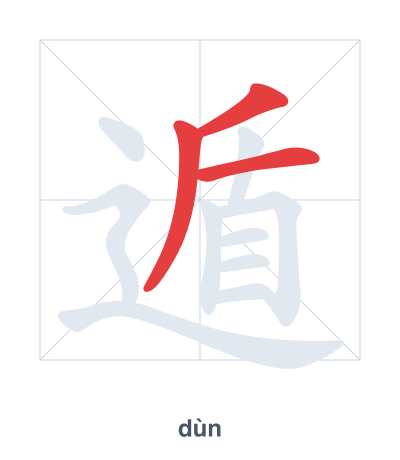
Open Hanzi Writer to see the animated stroke order and practice writing 遁 with real-time feedback.
The character 遁 (dùn) is written with 12 strokes. Follow the standard Chinese stroke order: top to bottom, left to right, outside before inside. The radical 辶 is one of its key components.
Practice the correct stroke order with the Hanzi Writer app to see animated stroke-by-stroke guidance with real-time feedback.
遁 means to escape; to vanish.
遁 combines the radical 辶 (walk/action) with 盾 (shield), which originally depicted a rectangular shield with a handle. Together, they suggest the idea of moving while shielded or hidden, hence 'to escape' or 'vanish'—as if fleeing under the cover of a shield.
💡 Memory Tip: Imagine a warrior hiding behind a shield (盾) and sneaking away (辶) to vanish from sight.
小偷飞快地遁走了。
xiǎo tōu fēi kuài dì dùn zǒu le
The thief quickly escaped.
坏人无处遁形。
huài rén wú chǔ dùn xíng
Bad people have nowhere to hide.
他遁入山林生活。
tā dùn rù shān lín shēng huó
He withdrew to the mountains to live in seclusion.
Open Hanzi Writer to see the animated stroke order and practice writing 遁 with real-time feedback.
✨ Animated stroke order · Handwriting recognition · HSK-graded practice · Free to use
The character 遁 combines the radical 辶 (walking or movement) with 盾 (dùn, shield). The shield suggests protection or hiding, while the walking radical indicates movement, together implying moving away while protected, i.e., escaping or vanishing.