憝 (duì) means "to hate" in Chinese. It has 16 strokes with the radical 心.
Rated 4.2/5 in difficulty (advanced).
Appears in 3+ common words including 元憝 (yuán duì), 凶憝 (xiōng duì), 奸憝 (jiān duì).
Due to its 16 strokes, Hanzi Writer's error detection shows 憝 requires focused practice — most learners need 10+ attempts for consistent accuracy.
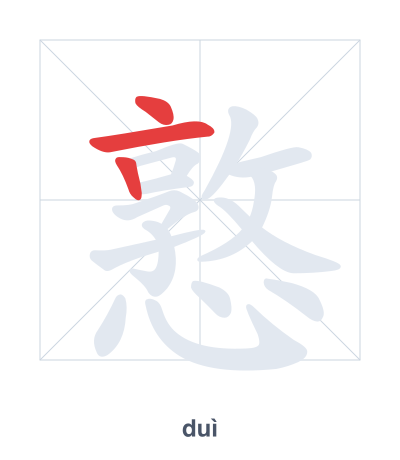
Open Hanzi Writer to see the animated stroke order and practice writing 憝 with real-time feedback.
The character 憝 (duì) is written with 16 strokes. Follow the standard Chinese stroke order: top to bottom, left to right, outside before inside. The radical 心 is one of its key components.
Practice the correct stroke order with the Hanzi Writer app to see animated stroke-by-stroke guidance with real-time feedback.
憝 means to hate.
This character combines the heart radical 心 (emotion) with 敦 (dūn, phonetic), which originally meant 'to press' or 'to urge'—evoking the oppressive and persistent nature of hatred.
💡 Memory Tip: Picture a heart (心) being crushed under a heavy pile of stones (敦) as you hatefully grind it down.
那个元憝被抓住了。
nà ge yuán duì bèi zhuā zhù le
That chief culprit was caught.
法律不会放过凶憝。
fǎ lǜ bú huì fàng guò xiōng duì
The law will not let the arch-villain go.
历史记住了那个奸憝。
lì shǐ jì zhù le nà ge jiān duì
History remembered that wicked villain.
Open Hanzi Writer to see the animated stroke order and practice writing 憝 with real-time feedback.
✨ Animated stroke order · Handwriting recognition · HSK-graded practice · Free to use
憝 is composed of a phonetic component 敦 (a top part meaning 'honest' or 'solid') and a semantic component 心 (heart) at the bottom. The 心 radical suggests that the meaning relates to emotions or feelings, and together they form the idea of 'solid hatred in the heart'.