慝 (tè) means "evil; vice; hidden evil" in Chinese. It has 14 strokes with the radical 心.
Rated 4.2/5 in difficulty (advanced).
Appears in 3+ common words including 奸慝 (jiān tè), 邪慝 (xié tè), 慝心 (tè xīn).
Due to its 14 strokes, Hanzi Writer's error detection shows 慝 requires focused practice — most learners need 10+ attempts for consistent accuracy.
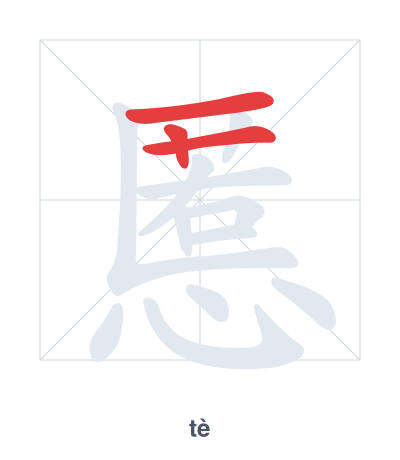
Open Hanzi Writer to see the animated stroke order and practice writing 慝 with real-time feedback.
The character 慝 (tè) is written with 14 strokes. Follow the standard Chinese stroke order: top to bottom, left to right, outside before inside. The radical 心 is one of its key components.
Practice the correct stroke order with the Hanzi Writer app to see animated stroke-by-stroke guidance with real-time feedback.
慝 means evil; vice; hidden evil.
慝 combines the heart radical 心 (mind/emotion) with 匿 (nì, 'to hide'), indicating an evil intent concealed deep within one's heart. The character 匿 itself shows a box (匚) with a person (若 simplified) hiding inside, reinforcing the idea of something wicked hidden away.
💡 Memory Tip: Picture a sneaky villain hiding a black heart (心) behind a mask (匿), secretly plotting wicked deeds while pretending to be nice.
这种行为很奸慝。
zhè zhǒng xíng wéi hěn jiān tè
This behavior is very wicked and evil.
他心存邪慝。
tā xīn cún xié tè
He had evil intentions in his heart.
莫起慝心。
mò qǐ tè xīn
Do not harbor evil intentions.
Open Hanzi Writer to see the animated stroke order and practice writing 慝 with real-time feedback.
✨ Animated stroke order · Handwriting recognition · HSK-graded practice · Free to use
慝 is composed of 匿 (nì, meaning "to hide") on top and 心 (xīn, meaning "heart") as the radical. Together, they suggest a "hidden heart" or evil intent that is concealed. This structure directly supports the character's meaning of hidden evil or vice.