啇 (dì) means "Root; legitimate (archaic character)." in Chinese. It has 11 strokes with the radical 口.
Rated 3.9/5 in difficulty (challenging).
Appears in 3+ common words including 啇子 (dì zi), 啇嗣 (dì sì), 根啇 (gēn dì).
Due to its 11 strokes, Hanzi Writer's error detection shows 啇 requires focused practice — most learners need 10+ attempts for consistent accuracy.
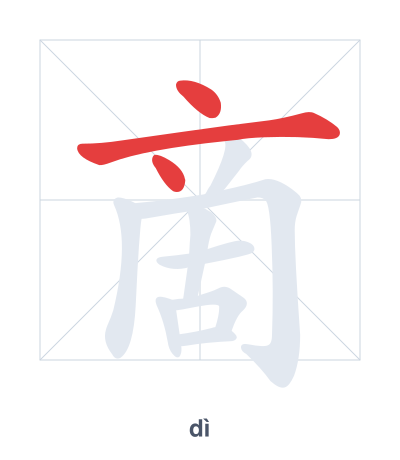
Open Hanzi Writer to see the animated stroke order and practice writing 啇 with real-time feedback.
The character 啇 (dì) is written with 11 strokes. Follow the standard Chinese stroke order: top to bottom, left to right, outside before inside. The radical 口 is one of its key components.
Practice the correct stroke order with the Hanzi Writer app to see animated stroke-by-stroke guidance with real-time feedback.
啇 means Root; legitimate (archaic character)..
啇 is composed of 亠 (a lid or top), 丷 (two dots or a spread), 冂 (a frame or enclosure), and 口 (mouth). The original form depicted a plant's stem with roots, where the top part represents the sprout and the bottom the root system. Over time, it evolved to represent the base or root of something, and later the legitimate or original line of descent.
💡 Memory Tip: Imagine a plant with a big mouth at the bottom, sucking up water from the roots—that's the 啇, the root of life.
他是家里的啇子。
tā shì jiā lǐ de dì zi
He is the legitimate son of the family.
谁是他的啇嗣?
shuí shì tā de dì sì
Who is his legitimate heir?
这件事有根啇。
zhè jiàn shì yǒu gēn dì
This matter has a foundation.
Open Hanzi Writer to see the animated stroke order and practice writing 啇 with real-time feedback.
✨ Animated stroke order · Handwriting recognition · HSK-graded practice · Free to use
啇 is a compound character. The top part 亠 with 丷 can be seen as a plant sprout, the middle 冂 is like a container or the ground, and the bottom 口 is a mouth or an opening. Together, they suggest something growing from a base. The mouth at the bottom symbolizes the source or root, which gives the character its meaning of 'root' or 'origin'.