痤 (cuó) means "acne" in Chinese. It has 12 strokes with the radical 疒.
Rated 4.2/5 in difficulty (advanced).
Appears in 3+ common words including 痤疮 (cuó chuāng), 长痤疮 (zhǎng cuó chuāng), 痤疮膏 (cuó chuāng gāo).
Due to its 12 strokes, Hanzi Writer's error detection shows 痤 requires focused practice — most learners need 10+ attempts for consistent accuracy.
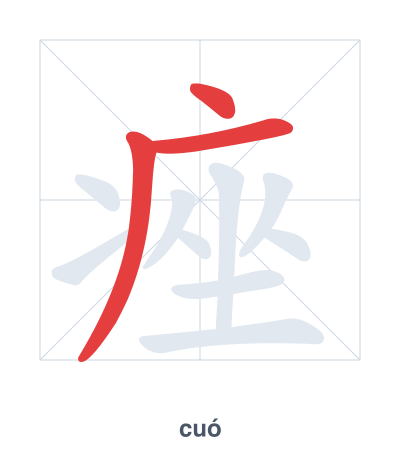
Open Hanzi Writer to see the animated stroke order and practice writing 痤 with real-time feedback.
The character 痤 (cuó) is written with 12 strokes. Follow the standard Chinese stroke order: top to bottom, left to right, outside before inside. The radical 疒 is one of its key components.
Practice the correct stroke order with the Hanzi Writer app to see animated stroke-by-stroke guidance with real-time feedback.
痤 means acne.
痤 is a phono-semantic compound: the left radical 疒 (illness) indicates a disease or skin condition, while the right component 坐 (sit) provides a phonetic clue and evokes the image of small bumps 'sitting' on the skin.
💡 Memory Tip: Imagine a zit (疒) with a tiny chair (坐) on top, because it just sits there stubbornly on your face.
医生在治疗他的痤疮。
yī shēng zài zhì liáo tā de cuó chuāng
The doctor is treating his acne.
他脸上长了很多痤疮。
tā liǎn shàng zhǎng le hěn duō cuó chuāng
He has a lot of acne on his face.
这种痤疮膏很有用。
zhè zhǒng cuó chuāng gāo hěn yǒu yòng
This acne cream is very useful.
Open Hanzi Writer to see the animated stroke order and practice writing 痤 with real-time feedback.
✨ Animated stroke order · Handwriting recognition · HSK-graded practice · Free to use
痤 is made of the radical 疒 (illness) on the left and the phonetic component 坐 (cuò or zuò) on the right. The radical 疒 indicates this character relates to a disease or skin condition, so together it means a skin problem like acne.