懵 (měng) means "dazed; confused" in Chinese. It has 18 strokes with the radical 忄.
Rated 4.2/5 in difficulty (advanced).
Appears in 3+ common words including 懵了 (měng le), 发懵 (fā měng), 懵懂 (měng dǒng).
Due to its 18 strokes, Hanzi Writer's error detection shows 懵 requires focused practice — most learners need 10+ attempts for consistent accuracy.
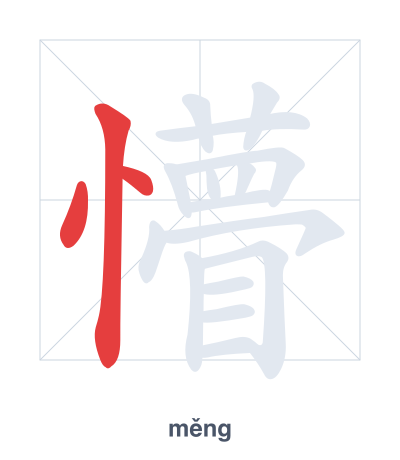
Open Hanzi Writer to see the animated stroke order and practice writing 懵 with real-time feedback.
The character 懵 (měng) is written with 18 strokes. Follow the standard Chinese stroke order: top to bottom, left to right, outside before inside. The radical 忄 is one of its key components.
Practice the correct stroke order with the Hanzi Writer app to see animated stroke-by-stroke guidance with real-time feedback.
懵 means dazed; confused.
懵 is a compound character made of the heart radical 忄 (xīn) on the left and 夢 (mèng, 'dream') on the right. The radical shows the emotion or mental state, while 夢 contributes both the sound and a hint of meaning, implying a mind lost in a dreamlike, confused haze.
💡 Memory Tip: Imagine your heart (忄) stuck in a foggy dream (夢), leaving you completely 懵 (dazed and confused).
我听完这话就懵了。
wǒ tīng wán zhè huà jiù měng le
I was stunned after hearing this.
这个问题让我发懵。
zhè ge wèn tí ràng wǒ fā měng
This question leaves me dazed.
他还是个懵懂的孩子。
tā hái shì gè měng dǒng de hái zi
He is still an ignorant child.
Open Hanzi Writer to see the animated stroke order and practice writing 懵 with real-time feedback.
✨ Animated stroke order · Handwriting recognition · HSK-graded practice · Free to use
The character 懵 is made of the heart radical 忄 on the left and 蒙 on the right. The heart radical connects to emotions or mental states, while 蒙 means "cover" or "deceive." Together, they suggest a mind that is covered or clouded, leading to a feeling of being dazed or confused.