曚 (méng) means "dim; twilight; dawn" in Chinese. It has 18 strokes with the radical 日.
Rated 4.2/5 in difficulty (advanced).
Appears in 3+ common words including 曚昽 (méng lóng), 曚曚 (méng méng), 曚昧 (méng mèi).
Due to its 18 strokes, Hanzi Writer's error detection shows 曚 requires focused practice — most learners need 10+ attempts for consistent accuracy.
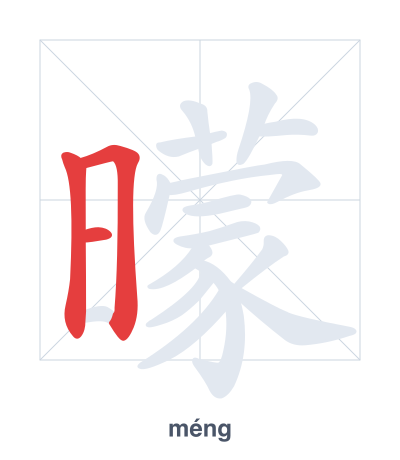
Open Hanzi Writer to see the animated stroke order and practice writing 曚 with real-time feedback.
The character 曚 (méng) is written with 18 strokes. Follow the standard Chinese stroke order: top to bottom, left to right, outside before inside. The radical 日 is one of its key components.
Practice the correct stroke order with the Hanzi Writer app to see animated stroke-by-stroke guidance with real-time feedback.
曚 means dim; twilight; dawn.
It combines the sun radical 日 (sun) with 蒙 (cover/obscure), depicting the sun being covered or veiled, which produces dim light at dawn or twilight.
💡 Memory Tip: Picture the sun (日) wrapped in a thick, fuzzy blanket (蒙) so its light is all dim and hazy.
晨光曚昽很美。
chén guāng méng lóng hěn měi
The hazy morning light is very beautiful.
天色曚曚亮了。
tiān sè méng méng liàng le
The sky is just beginning to dawn.
曚昧的晨光很柔。
méng mèi de chén guāng hěn róu
The dim morning light is very soft.
Open Hanzi Writer to see the animated stroke order and practice writing 曚 with real-time feedback.
✨ Animated stroke order · Handwriting recognition · HSK-graded practice · Free to use
曚 is made of the radical 日 (sun) on top and 蒙 below. 日 suggests light or time of day, while 蒙 conveys the idea of covering or obscuring. Together they create the image of sunlight being covered, leading to the meaning of dimness at dawn or dusk.