懮 (yǒu) means "sorrowful; grieved" in Chinese. It has 18 strokes with the radical 忄.
Rated 4.2/5 in difficulty (advanced).
Appears in 3+ common words including 懮受 (yǒu shòu), 懮戚 (yǒu qī), 懮懮 (yǒu yǒu).
Due to its 18 strokes, Hanzi Writer's error detection shows 懮 requires focused practice — most learners need 10+ attempts for consistent accuracy.
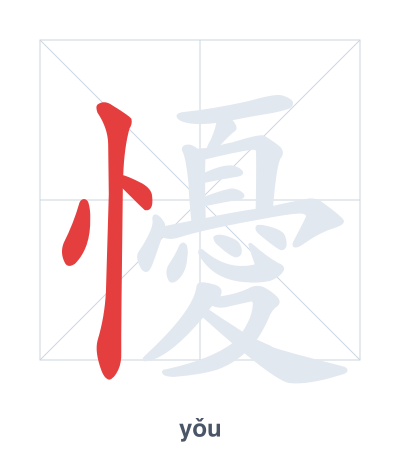
Open Hanzi Writer to see the animated stroke order and practice writing 懮 with real-time feedback.
The character 懮 (yǒu) is written with 18 strokes. Follow the standard Chinese stroke order: top to bottom, left to right, outside before inside. The radical 忄 is one of its key components.
Practice the correct stroke order with the Hanzi Writer app to see animated stroke-by-stroke guidance with real-time feedback.
懮 means sorrowful; grieved.
懮 is a compound character: the left radical 忄 (heart) indicates emotion, while the right side 憂 (yōu, 'worry') provides sound and also contributes the meaning of grief. Together, they depict a heart filled with worry, giving the sense of being sorrowful or grieved.
💡 Memory Tip: Picture a heavy heart (忄) sinking under the weight of a worried face (憂) with a big head and drooping body, causing deep sorrow.
懮受是古语。
yǒu shòu shì gǔ yǔ
'Youshou' is an archaic term.
两人同有懮戚。
liǎng rén tóng yǒu yǒu qī
The two share joys and sorrows.
他的样子很懮懮。
tā de yàng zi hěn yǒu yǒu
He looks sorrowful and worried.
Open Hanzi Writer to see the animated stroke order and practice writing 懮 with real-time feedback.
✨ Animated stroke order · Handwriting recognition · HSK-graded practice · Free to use
懮 is composed of the radical 忄 (heart) on the left and the component 憂 (yōu, worry) on the right. The heart radical indicates emotions, and 憂 contributes the sound and the core idea of worry or grief, together creating the meaning of deep sorrow.