嚣 (xiāo) means "Clamorous / Arrogant" in Chinese. It has 18 strokes with the radical 口.
Rated 4.2/5 in difficulty (advanced).
Appears in 3+ common words including 嚣张 (xiāo zhāng), 喧嚣 (xuān xiāo), 叫嚣 (jiào xiāo).
Due to its 18 strokes, Hanzi Writer's error detection shows 嚣 requires focused practice — most learners need 10+ attempts for consistent accuracy.
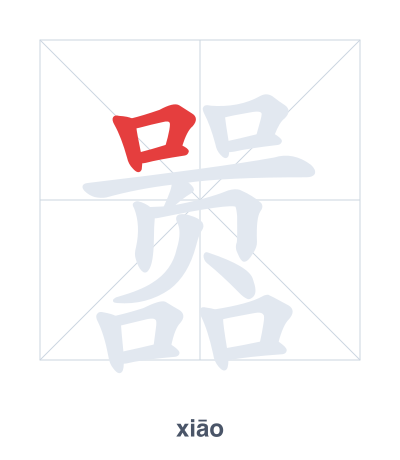
Open Hanzi Writer to see the animated stroke order and practice writing 嚣 with real-time feedback.
The character 嚣 (xiāo) is written with 18 strokes. Follow the standard Chinese stroke order: top to bottom, left to right, outside before inside. The radical 口 is one of its key components.
Practice the correct stroke order with the Hanzi Writer app to see animated stroke-by-stroke guidance with real-time feedback.
嚣 means Clamorous / Arrogant.
The character 嚣 is a compound that combines multiple 口 (mouths) around a central 页 (head), depicting many mouths shouting at a single person's head. This visual of clamorous noise from all sides conveys the meanings of 'clamorous' and 'arrogant'.
💡 Memory Tip: Picture a head (页) surrounded by four shouting mouths (口口口口) at a party—so loud and boastful that it becomes arrogantly annoying.
这个人说话很嚣张。
zhè ge rén shuō huà hěn xiāo zhāng
This person speaks very arrogantly and aggressively.
城市里非常喧嚣。
chéng shì lǐ fēi cháng xuān xiāo
The city is very noisy and bustling.
他在外面大声叫嚣。
tā zài wài miàn dà shēng jiào xiāo
He is clamoring loudly outside.
Open Hanzi Writer to see the animated stroke order and practice writing 嚣 with real-time feedback.
✨ Animated stroke order · Handwriting recognition · HSK-graded practice · Free to use
嚣 is made of two 口 (mouth) and two 页 (head/page) arranged in a 2x2 grid. The multiple mouths and heads suggest many people shouting loudly, which connects to the meaning "clamorous" or "arrogant." This structure visually represents noise and commotion.