膪 (chuài) means "flabby fat (especially on the belly)" in Chinese. It has 16 strokes with the radical 月.
Rated 4.2/5 in difficulty (advanced).
Appears in 3+ common words including 囊膪 (náng chuài), 肥膪 (féi chuài), 走膪 (zǒu chuài).
Due to its 16 strokes, Hanzi Writer's error detection shows 膪 requires focused practice — most learners need 10+ attempts for consistent accuracy.
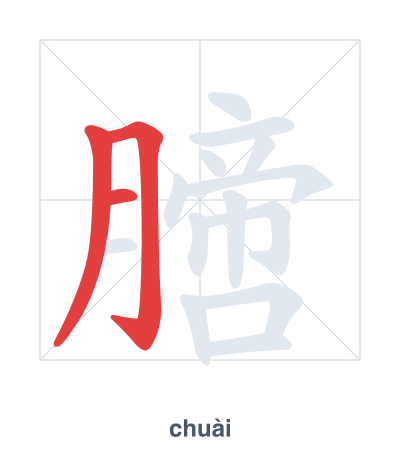
Open Hanzi Writer to see the animated stroke order and practice writing 膪 with real-time feedback.
The character 膪 (chuài) is written with 16 strokes. Follow the standard Chinese stroke order: top to bottom, left to right, outside before inside. The radical 月 is one of its key components.
Practice the correct stroke order with the Hanzi Writer app to see animated stroke-by-stroke guidance with real-time feedback.
膪 means flabby fat (especially on the belly).
膪 is a phono-semantic compound: the radical 月 (flesh/body part) indicates the meaning relates to the body, while the phonetic component 啻 (chuài) approximates the sound. This character specifically refers to loose, flabby fat on the belly, often describing the soft, sagging flesh associated with obesity or lack of muscle tone.
💡 Memory Tip: Picture a belly with a 'sash' (啻) that's too loose, jiggling like a wobbly pouch of fat under the moon-shaped radical 月.
囊膪不好吃。
náng chuài bù hǎo chī
Fatty pork belly doesn't taste good.
他肚子上有肥膪。
tā dǔ zi shàng yǒu féi chuài
He has flab on his belly.
这块肉已经走膪了。
zhè kuài ròu yǐ jīng zǒu chuài le
This piece of meat has gone soft and flabby.
Open Hanzi Writer to see the animated stroke order and practice writing 膪 with real-time feedback.
✨ Animated stroke order · Handwriting recognition · HSK-graded practice · Free to use
膪 is composed of the radical 月 (yue, meaning "moon" but used as a flesh radical) and the phonetic component 專 (zhuān). The 月 radical indicates the character relates to the body or flesh, while 專 hints at the pronunciation chuài. Together, they describe a specific type of flabby fat, especially on the belly.