膂 (lǚ) means "backbone / spine" in Chinese. It has 14 strokes with the radical 月.
Rated 4.2/5 in difficulty (advanced).
Appears in 3+ common words including 膂力 (lǚ lì), 膂力过人 (lǚ lì guò rén), 膂力强 (lǚ lì qiáng).
Due to its 14 strokes, Hanzi Writer's error detection shows 膂 requires focused practice — most learners need 10+ attempts for consistent accuracy.
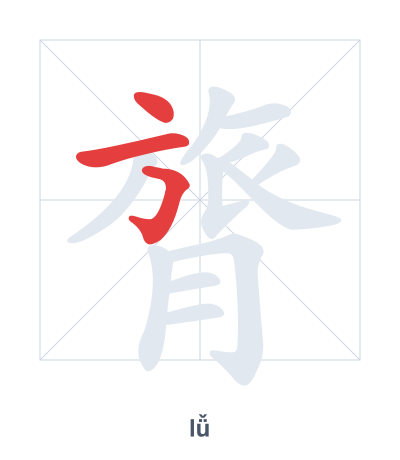
Open Hanzi Writer to see the animated stroke order and practice writing 膂 with real-time feedback.
The character 膂 (lǚ) is written with 14 strokes. Follow the standard Chinese stroke order: top to bottom, left to right, outside before inside. The radical 月 is one of its key components.
Practice the correct stroke order with the Hanzi Writer app to see animated stroke-by-stroke guidance with real-time feedback.
膂 means backbone / spine.
膂 is a phono-semantic compound: the left radical 月 (flesh/body) indicates it relates to a body part, while the right component 旅 (lǚ, meaning 'travel' or 'troop') provides the sound. The backbone is the central support that 'travels' down the body, much like a line of marching soldiers.
💡 Memory Tip: Picture a line of tiny travelers (旅) marching down the fleshy (月) backbone of your spine.
他的膂力很大。
tā de lǚ lì hěn dà
He has great physical strength.
他膂力过人。
tā lǚ lì guò rén
He has extraordinary physical strength.
锻炼增强膂力。
duàn liàn zēng qiáng lǚ lì
Exercise increases physical strength.
Open Hanzi Writer to see the animated stroke order and practice writing 膂 with real-time feedback.
✨ Animated stroke order · Handwriting recognition · HSK-graded practice · Free to use
The character 膂 combines the radical 月 (flesh/body part) on the left with the phonetic component 旅 (lǚ) on the right. The left side indicates that the character refers to a part of the body, specifically the spine or backbone. The right side provides the pronunciation lǚ.