伽 (gā/jiā) means "used in transliterations (e.g., yoga, gamma)" in Chinese. It has 7 strokes with the radical 亻.
Rated 3.2/5 in difficulty (challenging).
Appears in 3+ common words including 瑜伽 (yú jiā), 伽马 (gā mǎ), 僧伽 (sēng gā).
Due to its 7 strokes, Hanzi Writer's error detection shows 伽 requires focused practice — most learners need 10+ attempts for consistent accuracy.
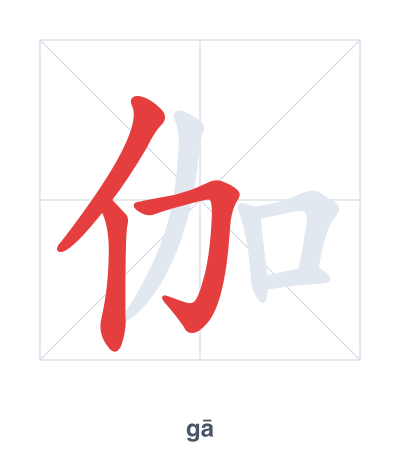
Open Hanzi Writer to see the animated stroke order and practice writing 伽 with real-time feedback.
The character 伽 (gā/jiā) is written with 7 strokes. Follow the standard Chinese stroke order: top to bottom, left to right, outside before inside. The radical 亻 is one of its key components.
Practice the correct stroke order with the Hanzi Writer app to see animated stroke-by-stroke guidance with real-time feedback.
伽 means used in transliterations (e.g., yoga, gamma).
This is a polyphonic character with readings: gā, jiā.
伽 is a compound character combining the person radical 亻 with the phonetic component 加 (jiā, 'add'). It is used in transliterations like yoga (瑜伽) and gamma (伽马), where the person radical hints at human activities such as yoga practice.
💡 Memory Tip: Picture a person (亻) adding (加) a new yoga pose and exclaiming 'Ga!' like gamma.
我喜欢做瑜伽。
wǒ xǐ huān zuò yú jiā
I like doing yoga.
这是伽马射线。
zhè shì gā mǎ shè xiàn
This is gamma radiation.
僧伽在寺庙里。
sēng gā zài sì miào lǐ
The Sangha is in the temple.
Open Hanzi Writer to see the animated stroke order and practice writing 伽 with real-time feedback.
✨ Animated stroke order · Handwriting recognition · HSK-graded practice · Free to use
伽 is made of the radical 亻 (person) on the left and 加 (add) on the right. Together they do not create a literal meaning; instead, 伽 is used as a phonetic character for transliterating foreign sounds like "ga" or "ja".