阑 (lán) means "late; end; railing" in Chinese. It has 12 strokes with the radical 门.
Rated 4.2/5 in difficulty (advanced).
Appears in 3+ common words including 阑尾 (lán wěi), 夜阑 (yè lán), 阑珊 (lán shān).
Due to its 12 strokes, Hanzi Writer's error detection shows 阑 requires focused practice — most learners need 10+ attempts for consistent accuracy.
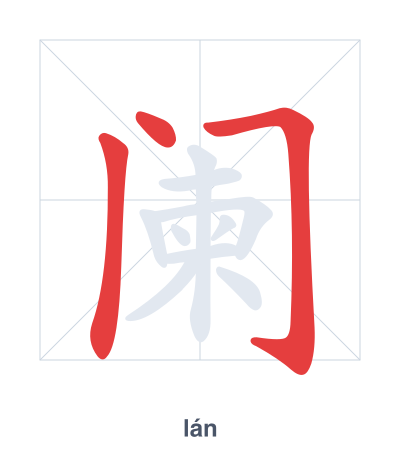
Open Hanzi Writer to see the animated stroke order and practice writing 阑 with real-time feedback.
The character 阑 (lán) is written with 12 strokes. Follow the standard Chinese stroke order: top to bottom, left to right, outside before inside. The radical 门 is one of its key components.
Practice the correct stroke order with the Hanzi Writer app to see animated stroke-by-stroke guidance with real-time feedback.
阑 means late; end; railing.
阑 combines the radical 门 (gate) with 柬 (select), which originally depicted a gate with a screen or railing. Over time, the character came to mean 'railing' and extended to 'late' or 'end' as in the final part of something, like the late hours of the night.
💡 Memory Tip: At the late hour, you lean on the railing (阑) inside the gate (门) as the day ends.
他得了阑尾炎。
tā dé le lán wěi yán
He got appendicitis.
夜阑人静的时候。
yè lán rén jìng de shí hòu
When the night is deep and all is quiet.
那人正在灯火阑珊处。
nà rén zhèng zài dēng huǒ lán shān chù
That person is where the lights are dim.
Open Hanzi Writer to see the animated stroke order and practice writing 阑 with real-time feedback.
✨ Animated stroke order · Handwriting recognition · HSK-graded practice · Free to use
阑 is made of the radical 门 (gate) on the outside and 柬 (to select) inside. The 门 radical suggests a barrier or enclosure, connecting to the meaning "railing." The inside part 柬 may hint at the idea of something being "selected" or "limited," which relates to "late" or "end."