踌 (chóu) means "to hesitate" in Chinese. It has 14 strokes with the radical 足.
Rated 4.2/5 in difficulty (advanced).
Appears in 3+ common words including 踌躇 (chóu chú), 踌躇满志 (chóu chú mǎn zhì), 略微踌躇 (lüè wēi chóu chú).
Due to its 14 strokes, Hanzi Writer's error detection shows 踌 requires focused practice — most learners need 10+ attempts for consistent accuracy.
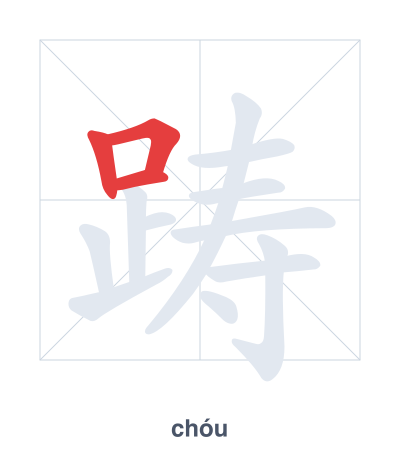
Open Hanzi Writer to see the animated stroke order and practice writing 踌 with real-time feedback.
The character 踌 (chóu) is written with 14 strokes. Follow the standard Chinese stroke order: top to bottom, left to right, outside before inside. The radical 足 is one of its key components.
Practice the correct stroke order with the Hanzi Writer app to see animated stroke-by-stroke guidance with real-time feedback.
踌 means to hesitate.
踌 is a compound character with the radical 足 (foot), indicating movement or walking, and the component 寿 (long life) providing the sound. The combination suggests the action of pacing back and forth or slowing down, which relates to hesitation—a hesitant person's feet linger instead of moving forward decisively.
💡 Memory Tip: Imagine a foot (足) that takes a long, slow life (寿) to decide where to step—it hesitates with every move.
他在门口踌躇不前。
tā zài mén kǒu chóu chú bù qián
He is hesitating to move forward at the door.
他看起来踌躇满志。
tā kàn qǐ lái chóu chú mǎn zhì
He looks enormously proud of his success.
他略微踌躇了一下。
tā lüè wēi chóu chú le yī xià
He hesitated for a moment.
Open Hanzi Writer to see the animated stroke order and practice writing 踌 with real-time feedback.
✨ Animated stroke order · Handwriting recognition · HSK-graded practice · Free to use
踌 combines the radical 足 (foot) on the left with the phonetic component 寿 on the right. The foot radical hints at movement or action, while the overall character means "to hesitate" — as if one’s feet are uncertain where to step.