辱 (rǔ) means "to insult; to humiliate; disgrace." in Chinese. It has 10 strokes with the radical 辰, and is HSK Level 7.
Rated 3.8/5 in difficulty (challenging).
Harder than 33% of HSK Level 7 characters.
Appears in 3+ common words including 侮辱 (wǔ rǔ), 耻辱 (chǐ rǔ), 辱骂 (rǔ mà).
Due to its 10 strokes, Hanzi Writer's error detection shows 辱 requires focused practice — most learners need 10+ attempts for consistent accuracy.
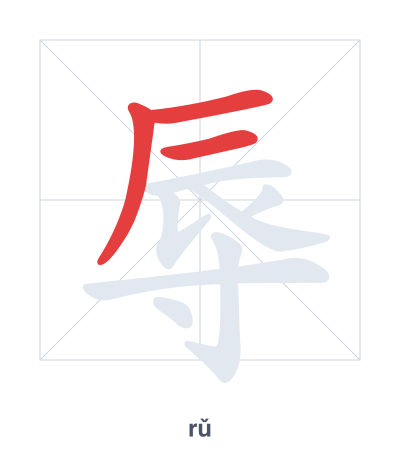
Open Hanzi Writer to see the animated stroke order and practice writing 辱 with real-time feedback.
The character 辱 (rǔ) is written with 10 strokes. Follow the standard Chinese stroke order: top to bottom, left to right, outside before inside. The radical 辰 is one of its key components.
Practice the correct stroke order with the Hanzi Writer app to see animated stroke-by-stroke guidance with real-time feedback.
辱 means to insult; to humiliate; disgrace..
As an HSK Level 7 character, 辱 is an intermediate-level character.
The character 辱 originally depicted a hand (寸) holding a farming tool or shell (辰), likely representing the action of weeding or scraping; later it was borrowed phonetically to mean 'to insult' or 'disgrace', perhaps because being treated like dirt was humiliating.
💡 Memory Tip: Imagine a hand (寸) flinging a filthy shell (辰) at someone’s face—a quick, nasty insult.
我们不能侮辱他人。
wǒ men bù néng wǔ rǔ tā rén
We cannot insult others.
失败并不是一种耻辱。
shī bài bìng bú shì yī zhǒng chǐ rǔ
Failure is not a disgrace.
他在街上辱骂路人。
tā zài jiē shàng rǔ mà lù rén
He is insulting passers-by on the street.
Open Hanzi Writer to see the animated stroke order and practice writing 辱 with real-time feedback.
✨ Animated stroke order · Handwriting recognition · HSK-graded practice · Free to use
The character 辱 has the radical 辰 (a large shell or early morning) as its base, and the upper part is 寸 (meaning 'hand' or 'measure'). Together, they suggest the idea of 'losing face' or being disgraced, as if a hand is pressing down on one's honor.