缠 (chán) means "to wind; to wrap; to pester" in Chinese. It has 13 strokes with the radical 纟, and is HSK Level 7.
Rated 4.2/5 in difficulty (advanced).
Harder than 81% of HSK Level 7 characters.
Appears in 3+ common words including 纠缠 (jiū chán), 缠绕 (chán rào), 难缠 (nán chán).
Due to its 13 strokes, Hanzi Writer's error detection shows 缠 requires focused practice — most learners need 10+ attempts for consistent accuracy.
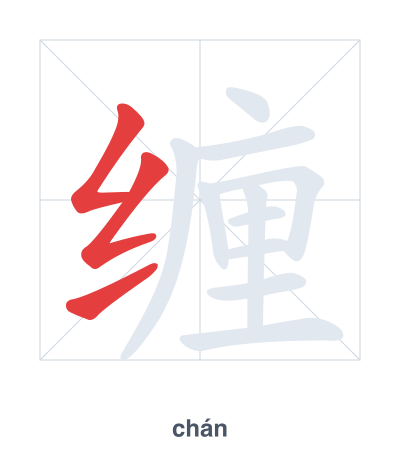
Open Hanzi Writer to see the animated stroke order and practice writing 缠 with real-time feedback.
The character 缠 (chán) is written with 13 strokes. Follow the standard Chinese stroke order: top to bottom, left to right, outside before inside. The radical 纟 is one of its key components.
Practice the correct stroke order with the Hanzi Writer app to see animated stroke-by-stroke guidance with real-time feedback.
缠 means to wind; to wrap; to pester.
As an HSK Level 7 character, 缠 is an intermediate-level character.
缠 combines the silk radical (纟), indicating thread or winding, with 廛 (chán), which originally depicted a farmstead with surrounding fields. Together, they suggest the image of thread or vines winding around and entangling a dwelling, conveying the meanings 'to wind, wrap, or pester.'
💡 Memory Tip: Picture a stubborn vine (纟) wrapping tightly around a little farmhouse (廛), pestering it endlessly.
别再纠缠我了。
bié zài jiū chán wǒ le
Stop pestering me.
绳子缠绕在树上。
shéng zi chán rào zài shù shàng
The rope is wound around the tree.
这个人很难缠。
zhè ge rén hěn nán chán
This person is very difficult to deal with.
Open Hanzi Writer to see the animated stroke order and practice writing 缠 with real-time feedback.
✨ Animated stroke order · Handwriting recognition · HSK-graded practice · Free to use
缠 is made of two parts: left side 纟 (silk thread) and right side 廛 (a character meaning 'dwelling' or 'shop' and also serving as a pronunciation hint). The silk radical shows that the character relates to threads or binding, so 缠 means to wind or wrap something around, like using string. The right part gives the sound 'chán' but does not directly contribute to the meaning.