猹 (chá) means "A badger-like animal" in Chinese. It has 12 strokes with the radical 犭.
Rated 4.2/5 in difficulty (advanced).
Appears in 3+ common words including 猹 (chá), 猹子 (chá zi), 偷瓜的猹 (tōu guā de chá).
Due to its 12 strokes, Hanzi Writer's error detection shows 猹 requires focused practice — most learners need 10+ attempts for consistent accuracy.
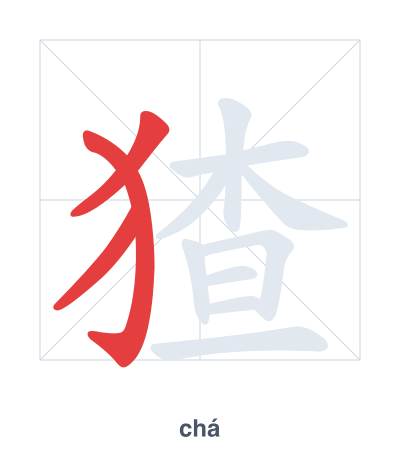
Open Hanzi Writer to see the animated stroke order and practice writing 猹 with real-time feedback.
The character 猹 (chá) is written with 12 strokes. Follow the standard Chinese stroke order: top to bottom, left to right, outside before inside. The radical 犭 is one of its key components.
Practice the correct stroke order with the Hanzi Writer app to see animated stroke-by-stroke guidance with real-time feedback.
猹 means A badger-like animal.
猹 is a phono-semantic compound: the radical 犭 (animal) indicates it's a creature, and the phonetic component 查 (chá, 'to examine') provides pronunciation. This character was famously coined by the Chinese writer Lu Xun in his story 'A Madman's Diary' to refer to a badger-like animal that eats melons.
💡 Memory Tip: A badger (犭) is checking (查) under a tree (木 with a sun on top) for hidden melons, its nose twitching as it sniffs the ground.
猹在偷吃西瓜。
chá zài tōu chī xī guā
The badger-like animal is stealing watermelons.
猹子跑得很快。
chá zi pǎo dé hěn kuài
The badger-like animal runs very fast.
鲁迅写过偷瓜的猹。
lǔ xùn xiě guò tōu guā de chá
Lu Xun wrote about the badger stealing melons.
Open Hanzi Writer to see the animated stroke order and practice writing 猹 with real-time feedback.
✨ Animated stroke order · Handwriting recognition · HSK-graded practice · Free to use
The character 猹 is composed of the radical 犭 (animal) on the left and the phonetic component 查 (chá) on the right. The radical shows the word relates to an animal, while 查 provides the pronunciation. Together, they create the meaning "a badger-like animal."