狳 (yú) means "armadillo (component)" in Chinese. It has 10 strokes with the radical 犭.
Rated 4.2/5 in difficulty (advanced).
Appears in 3+ common words including 犰狳 (qiú yú), 犰狳壳 (qiú yú ké), 小犰狳 (xiǎo qiú yú).
Due to its 10 strokes, Hanzi Writer's error detection shows 狳 requires focused practice — most learners need 10+ attempts for consistent accuracy.
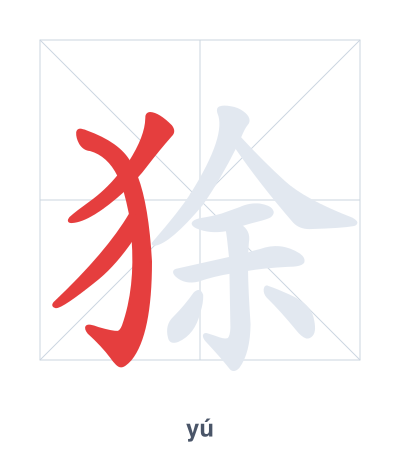
Open Hanzi Writer to see the animated stroke order and practice writing 狳 with real-time feedback.
The character 狳 (yú) is written with 10 strokes. Follow the standard Chinese stroke order: top to bottom, left to right, outside before inside. The radical 犭 is one of its key components.
Practice the correct stroke order with the Hanzi Writer app to see animated stroke-by-stroke guidance with real-time feedback.
狳 means armadillo (component).
狳 is a phono-semantic compound character. The radical 犭 (animal/dog) indicates it belongs to the beast category, while the right component 余 (yú, meaning 'surplus' or 'I') provides the pronunciation. It is used mainly in the term 犰狳 (qiúyú), meaning 'armadillo,' an animal with extra armored bands.
💡 Memory Tip: Picture a beast (犭) with so many armor plates that it has a surplus (余) of them — that's the armadillo (狳).
我见过犰狳。
wǒ jiàn guò qiú yú
I have seen an armadillo.
犰狳壳非常硬。
qiú yú ké fēi cháng yìng
The armadillo's shell is very hard.
这是一只小犰狳。
zhè shì yī zhī xiǎo qiú yú
This is a little armadillo.
Open Hanzi Writer to see the animated stroke order and practice writing 狳 with real-time feedback.
✨ Animated stroke order · Handwriting recognition · HSK-graded practice · Free to use
狳 is composed of the radical 犭 (animal/dog radical) on the left and the phonetic component 余 (yú) on the right. The radical 犭 indicates the character relates to animals, while 余 provides the pronunciation. Together they form the component meaning "armadillo," specifically in the compound word 犰狳 (qiú yú).