掺 (càn/chān) means "to mix; to blend; to adulterate" in Chinese. It has 11 strokes with the radical 扌, and is HSK Level 7.
Rated 4.2/5 in difficulty (advanced).
Harder than 59% of HSK Level 7 characters.
Appears in 3+ common words including 掺水 (càn shuǐ), 掺假 (càn jiǎ), 掺和 (chān huo).
Due to its 11 strokes, Hanzi Writer's error detection shows 掺 requires focused practice — most learners need 10+ attempts for consistent accuracy.
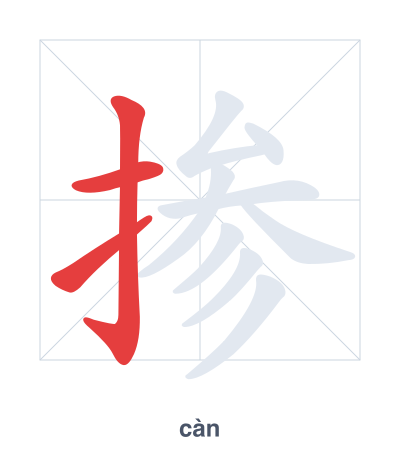
Open Hanzi Writer to see the animated stroke order and practice writing 掺 with real-time feedback.
The character 掺 (càn/chān) is written with 11 strokes. Follow the standard Chinese stroke order: top to bottom, left to right, outside before inside. The radical 扌 is one of its key components.
Practice the correct stroke order with the Hanzi Writer app to see animated stroke-by-stroke guidance with real-time feedback.
掺 means to mix; to blend; to adulterate.
This is a polyphonic character with readings: càn, chān.
As an HSK Level 7 character, 掺 is an intermediate-level character.
The character 掺 combines the hand radical 扌 with 参, which originally meant 'to join' or 'to participate.' The hand radical indicates the action of using one's hands to physically mix or blend, while 参 contributes the sense of combining or adulterating substances together.
💡 Memory Tip: Picture a hand (扌) stirring three different ingredients (参 looks like three parts: top 厶, middle 大, bottom 彡) into a single messy blend.
老板承诺自家的果汁绝不往里面掺水。
lǎo bǎn chéng nuò zì jiā de guǒ zhī jué bù wǎng lǐ miàn càn shuǐ 。
The boss promised that their juice is never watered down.
这种酒没有掺假。
zhè zhǒng jiǔ méi yǒu càn jiǎ
This wine is not adulterated.
你别瞎掺和。
nǐ bié xiā chān huo
Don't meddle in this.
Open Hanzi Writer to see the animated stroke order and practice writing 掺 with real-time feedback.
✨ Animated stroke order · Handwriting recognition · HSK-graded practice · Free to use
The character 掺 has the radical 扌 on the left, which means "hand" and indicates actions done with hands. The right side is 参 (cān), which originally means "to join" or "to participate," so together the character suggests the hand action of joining or mixing things together.