踣 (bó) means "to fall prostrate; to fall down" in Chinese. It has 15 strokes with the radical 足.
Rated 4.2/5 in difficulty (advanced).
Appears in 3+ common words including 踣地 (bó dì), 屡踣屡起 (lǚ bó lǚ qǐ), 颠踣 (diān bó).
Due to its 15 strokes, Hanzi Writer's error detection shows 踣 requires focused practice — most learners need 10+ attempts for consistent accuracy.
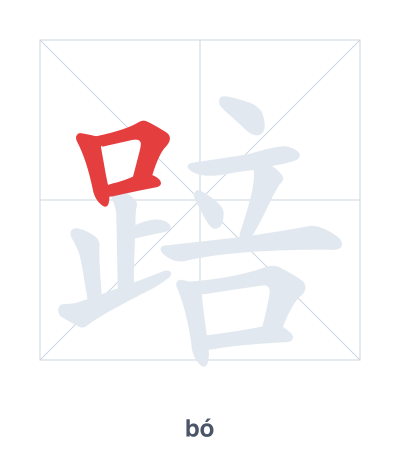
Open Hanzi Writer to see the animated stroke order and practice writing 踣 with real-time feedback.
The character 踣 (bó) is written with 15 strokes. Follow the standard Chinese stroke order: top to bottom, left to right, outside before inside. The radical 足 is one of its key components.
Practice the correct stroke order with the Hanzi Writer app to see animated stroke-by-stroke guidance with real-time feedback.
踣 means to fall prostrate; to fall down.
踣 is a compound character, composed of the semantic radical 足 (foot) and the phonetic component 咅 (pǒu). The radical indicates an action of the foot or leg, while the phonetic provides a sound cue; together they convey the idea of stumbling or falling prostrate due to loss of footing.
💡 Memory Tip: Imagine your foot (足) trips on a root, and you fall with a loud “pǒu” (咅) sound, landing flat on the ground.
他突然踣地而死。
tā tū rán bó dì ér sǐ
He suddenly fell to the ground and died.
他屡踣屡起,永不放弃。
tā lǚ bó lǚ qǐ yǒng bù fàng qì
He fell and got back up again and again, never giving up.
生活中难免有颠踣。
shēng huó zhōng nán miǎn yǒu diān bó
Ups and downs are inevitable in life.
Open Hanzi Writer to see the animated stroke order and practice writing 踣 with real-time feedback.
✨ Animated stroke order · Handwriting recognition · HSK-graded practice · Free to use
The left side is the radical 足 (zú), meaning "foot," which shows that the character involves foot action. The right side is 咅 (pǒu), which provides the sound and hints at the action of falling flat. Together, they create the image of a foot stumbling or falling to the ground.