摒 (bǐng) means "to discard; to get rid of" in Chinese. It has 12 strokes with the radical 扌.
Rated 4.2/5 in difficulty (advanced).
Appears in 3+ common words including 摒弃 (bǐng qì), 摒除 (bǐng chú), 摒绝 (bǐng jué).
Due to its 12 strokes, Hanzi Writer's error detection shows 摒 requires focused practice — most learners need 10+ attempts for consistent accuracy.
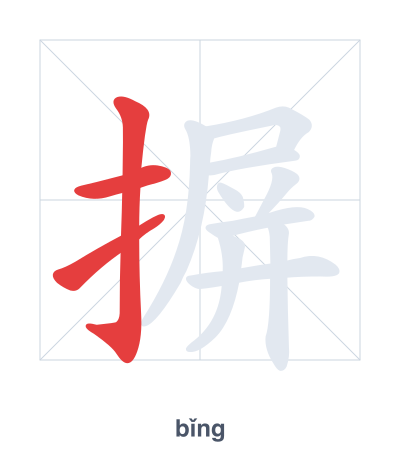
Open Hanzi Writer to see the animated stroke order and practice writing 摒 with real-time feedback.
The character 摒 (bǐng) is written with 12 strokes. Follow the standard Chinese stroke order: top to bottom, left to right, outside before inside. The radical 扌 is one of its key components.
Practice the correct stroke order with the Hanzi Writer app to see animated stroke-by-stroke guidance with real-time feedback.
摒 means to discard; to get rid of.
摒 is a phono-semantic compound where the radical 扌 (hand) indicates an action, and the phonetic component 并 (bǐng, meaning 'combine') provides the sound. The hand radical suggests physically pushing aside or removing something combined, leading to the meaning 'to discard or get rid of.'
💡 Memory Tip: Picture your hand (扌) pushing away a pile of stuff that has been combined (并) into a messy heap to discard it.
摒弃陈旧的观念。
bǐng qì chén jiù de guān niàn
Discard outdated concepts.
摒除一切外界干扰。
bǐng chú yī qiè wài jiè gān rǎo
Eliminate all external interference.
他摒绝了所有社交。
tā bǐng jué le suǒ yǒu shè jiāo
He cut off all social interactions.
Open Hanzi Writer to see the animated stroke order and practice writing 摒 with real-time feedback.
✨ Animated stroke order · Handwriting recognition · HSK-graded practice · Free to use
摒 is composed of the radical 扌 (hand) on the left, and the phonetic component 屏 (bǐng, meaning screen or shield) on the right. The hand radical suggests an action done with the hand, while 屏 adds the idea of blocking or pushing away, together indicating the action of discarding or getting rid of something.