豆 (dòu) means "bean; pea" in Chinese. It has 7 strokes with the radical 豆, and is HSK Level 4.
Rated 2.8/5 in difficulty (moderate).
Harder than 7% of HSK Level 4 characters.
Appears in 3+ common words including 豆腐 (dòu fǔ), 红豆 (hóng dòu), 豆浆 (dòu jiāng).
Hanzi Writer's stroke validation shows learners typically need 5-8 attempts to write 豆 with correct proportion and order.
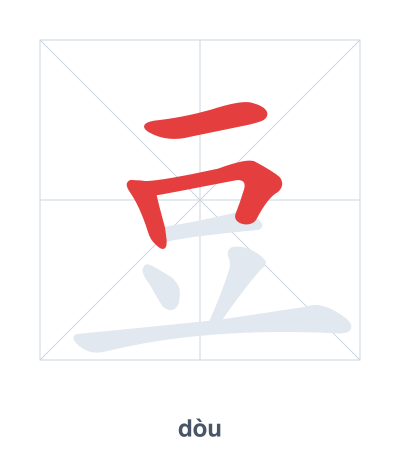
Open Hanzi Writer to see the animated stroke order and practice writing 豆 with real-time feedback.
The character 豆 (dòu) is written with 7 strokes. Follow the standard Chinese stroke order: top to bottom, left to right, outside before inside. The radical 豆 is one of its key components.
Practice the correct stroke order with the Hanzi Writer app to see animated stroke-by-stroke guidance with real-time feedback.
豆 means bean; pea.
As an HSK Level 4 character, 豆 is an intermediate-level character.
豆 originally depicted a tall, stemmed vessel used for ritual offerings, but was later borrowed to mean 'bean' because beans were often stored in such containers. The character's shape still resembles a vessel with a wide body and a stem, which also echoes the form of a bean pod with its two halves.
💡 Memory Tip: Imagine a bean (the square part) with a little stem on top and two tiny legs below, like a walking bean!
我喜欢吃麻婆豆腐。
wǒ xǐ huān chī má pó dòu fǔ
I like eating Mapo Tofu.
红豆可以煮粥。
hóng dòu kě yǐ zhǔ zhōu
Red beans can be used to make porridge.
早餐我喝了一杯豆浆。
zǎo cān wǒ hē le yī bēi dòu jiāng
I drank a cup of soy milk for breakfast.
Open Hanzi Writer to see the animated stroke order and practice writing 豆 with real-time feedback.
✨ Animated stroke order · Handwriting recognition · HSK-graded practice · Free to use
豆 is a pictograph that originally depicted a tall, round-bottomed container used for serving food, especially beans. Over time, its meaning shifted to refer specifically to the beans or peas themselves, and today it stands for 'bean' or 'pea' in Chinese.