癍 (bān) means "skin spot; macula" in Chinese. It has 17 strokes with the radical 疒.
Rated 4.2/5 in difficulty (advanced).
Appears in 3+ common words including 癍疹 (bān zhěn), 汗癍 (hàn bān), 癍子 (bān zi).
Due to its 17 strokes, Hanzi Writer's error detection shows 癍 requires focused practice — most learners need 10+ attempts for consistent accuracy.
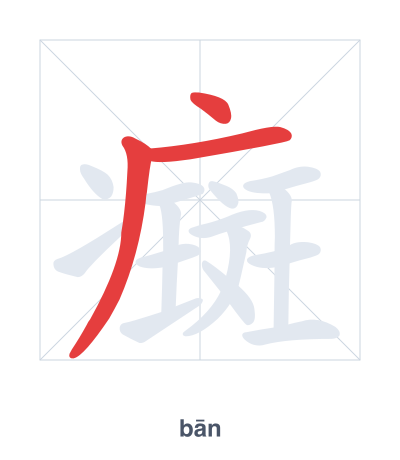
Open Hanzi Writer to see the animated stroke order and practice writing 癍 with real-time feedback.
The character 癍 (bān) is written with 17 strokes. Follow the standard Chinese stroke order: top to bottom, left to right, outside before inside. The radical 疒 is one of its key components.
Practice the correct stroke order with the Hanzi Writer app to see animated stroke-by-stroke guidance with real-time feedback.
癍 means skin spot; macula.
癍 combines the illness radical 疒 (a sickbed) with 斑 (bān, 'spot'), which itself depicts a pattern of spots (文 meaning pattern, with 玨 representing two jade pieces). Together, 癍 indicates a skin condition marked by spotted or blotchy discoloration, such as a macula or birthmark.
💡 Memory Tip: Imagine a sick person (疒) covered in spots like a leopard (斑) – each spot is a tiny jade piece (玨) making patterns (文) on their skin.
孩子身上有癍疹。
hái zi shēn shàng yǒu bān zhěn
The child has spots or a rash on their body.
夏天容易长汗癍。
xià tiān róng yì zhǎng hàn bān
It is easy to get sweat spots in summer.
脸上长了癍子。
liǎn shàng zhǎng le bān zi
Spots or blemishes appeared on the face.
Open Hanzi Writer to see the animated stroke order and practice writing 癍 with real-time feedback.
✨ Animated stroke order · Handwriting recognition · HSK-graded practice · Free to use
The character 癍 combines the radical 疒 (illness) on the left with the phonetic component 斑 (bān, spot) on the right. The radical indicates a disease or skin condition, while the right side hints at the pronunciation and the concept of spots or patches. Together they mean a skin spot or macula caused by illness.