瘛 (chì) means "convulsion; spasm" in Chinese. It has 15 strokes with the radical 疒.
Rated 4.2/5 in difficulty (advanced).
Appears in 3+ common words including 瘛疭 (chì zòng), 抽瘛 (chōu chì), 瘛病 (chì bìng).
Due to its 15 strokes, Hanzi Writer's error detection shows 瘛 requires focused practice — most learners need 10+ attempts for consistent accuracy.
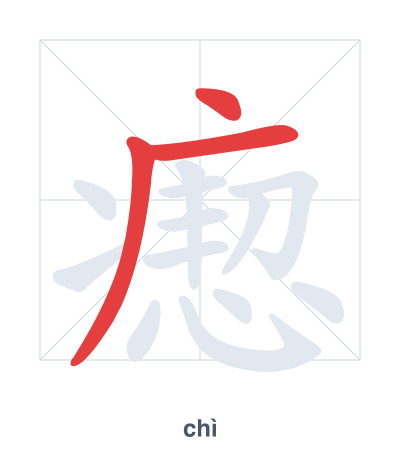
Open Hanzi Writer to see the animated stroke order and practice writing 瘛 with real-time feedback.
The character 瘛 (chì) is written with 15 strokes. Follow the standard Chinese stroke order: top to bottom, left to right, outside before inside. The radical 疒 is one of its key components.
Practice the correct stroke order with the Hanzi Writer app to see animated stroke-by-stroke guidance with real-time feedback.
瘛 means convulsion; spasm.
瘛 is a compound character formed with the disease radical 疒 and a phonetic component that resembles a contracted, twisting shape. The radical indicates an illness, while the right side visually suggests the jerky, uncontrolled movements of a spasm or convulsion.
💡 Memory Tip: Picture a person with a sick body (疒) whose limbs are twisted like a pretzel (the right side's chaotic strokes) in a convulsion.
他手脚有些瘛疭。
tā shǒu jiǎo yǒu xiē chì zòng
His limbs are twitching slightly.
他的肌肉在抽瘛。
tā de jī ròu zài chōu chì
His muscles are twitching.
这种瘛病很少见。
zhè zhǒng chì bìng hěn shǎo jiàn
This type of convulsion is very rare.
Open Hanzi Writer to see the animated stroke order and practice writing 瘛 with real-time feedback.
✨ Animated stroke order · Handwriting recognition · HSK-graded practice · Free to use
The character 瘛 has the radical 疒 on the outside, which means "illness" or "sickness." Inside is 契 (qì), which provides a phonetic hint but also suggests a cutting or binding action. Together, they indicate a disease involving sudden, involuntary muscle contractions like convulsions.