疹 (zhěn) means "rash" in Chinese. It has 10 strokes with the radical 疒.
Rated 4.2/5 in difficulty (advanced).
Appears in 3+ common words including 疹子 (zhěn zi), 湿疹 (shī zhěn), 风疹 (fēng zhěn).
Due to its 10 strokes, Hanzi Writer's error detection shows 疹 requires focused practice — most learners need 10+ attempts for consistent accuracy.
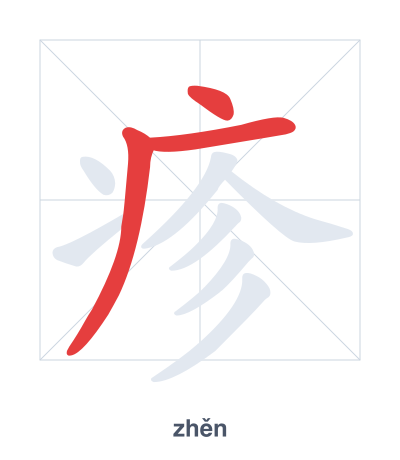
Open Hanzi Writer to see the animated stroke order and practice writing 疹 with real-time feedback.
The character 疹 (zhěn) is written with 10 strokes. Follow the standard Chinese stroke order: top to bottom, left to right, outside before inside. The radical 疒 is one of its key components.
Practice the correct stroke order with the Hanzi Writer app to see animated stroke-by-stroke guidance with real-time feedback.
疹 means rash.
疹 is a phono-semantic compound: the radical 疒 (illness) indicates a disease, while the component 㐱 (zhěn) provides the pronunciation and originally depicted small bumps or spots on skin, together meaning 'rash'.
💡 Memory Tip: Picture a sick person (疒) with three tiny red dots (㐱) scattered across their skin—that's a rash.
孩子身上出疹子了。
hái zi shēn shàng chū zhěn zi le
The child has a rash on their body.
这种湿疹很难受。
zhè zhǒng shī zhěn hěn nán shòu
This eczema is very uncomfortable.
他得了风疹。
tā dé le fēng zhěn
He got rubella.
Open Hanzi Writer to see the animated stroke order and practice writing 疹 with real-time feedback.
✨ Animated stroke order · Handwriting recognition · HSK-graded practice · Free to use
The character 疹 consists of the radical 疒 (illness or sickness) on the left, and the phonetic component 㐱 (zhěn) on the right. The radical 疒 indicates that 疹 is related to disease, specifically a skin condition like a rash. Together, the character conveys the idea of a skin illness with red spots or bumps.