瘜 (xī) means "polyp" in Chinese. It has 15 strokes with the radical 疒.
Rated 4.2/5 in difficulty (advanced).
Appears in 3+ common words including 瘜肉 (xī ròu), 鼻瘜 (bí xī), 喉瘜 (hóu xī).
Due to its 15 strokes, Hanzi Writer's error detection shows 瘜 requires focused practice — most learners need 10+ attempts for consistent accuracy.
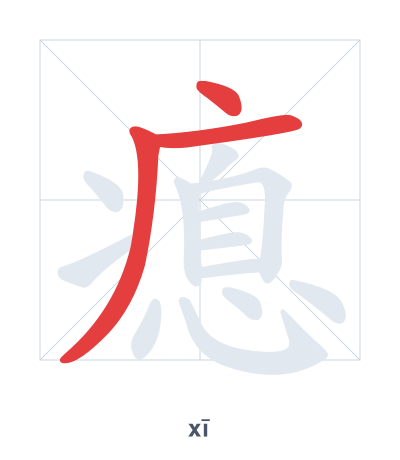
Open Hanzi Writer to see the animated stroke order and practice writing 瘜 with real-time feedback.
The character 瘜 (xī) is written with 15 strokes. Follow the standard Chinese stroke order: top to bottom, left to right, outside before inside. The radical 疒 is one of its key components.
Practice the correct stroke order with the Hanzi Writer app to see animated stroke-by-stroke guidance with real-time feedback.
瘜 means polyp.
This character is a compound of 疒 (sickness) and 息 (breath/rest). The 息 component provides the phonetic hint and also suggests the characteristic of a polyp as a growth that can obstruct normal breathing or 'rest' in a cavity. Together, the form points to a disease involving a fleshy outgrowth that interferes with breath.
💡 Memory Tip: Picture a sick nose (疒) with a little blob suffocating its breath (息)—that's the polyp blocking the airway.
医生切除了瘜肉。
yī shēng qiē chú le xī ròu
The doctor removed the polyp.
他的鼻瘜影响呼吸。
tā de bí xī yǐng xiǎng hū xī
His nasal polyps affect his breathing.
喉瘜让他声音沙哑。
hóu xī ràng tā shēng yīn shā yǎ
Throat polyps made his voice hoarse.
Open Hanzi Writer to see the animated stroke order and practice writing 瘜 with real-time feedback.
✨ Animated stroke order · Handwriting recognition · HSK-graded practice · Free to use
瘜 has the radical 疒, which means illness or disease, and the component 息, which means breath or rest. This structure suggests a growth that affects breathing, like a nasal polyp. The radical shows it is a medical condition, while 息 points to the symptom of blocked airways.