聱 (áo) means "difficult to pronounce; harsh" in Chinese. It has 16 strokes with the radical 耳.
Rated 4.2/5 in difficulty (advanced).
Appears in 3+ common words including 聱牙 (áo yá), 聱口 (áo kǒu), 佶屈聱牙 (jí qū áo yá).
Due to its 16 strokes, Hanzi Writer's error detection shows 聱 requires focused practice — most learners need 10+ attempts for consistent accuracy.
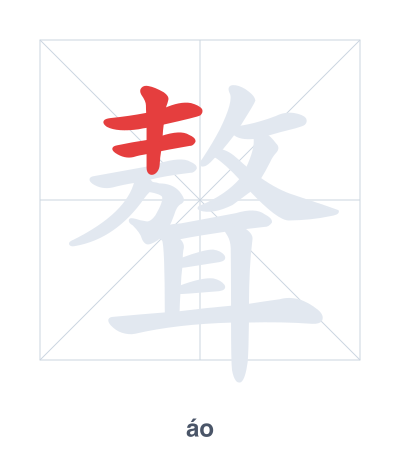
Open Hanzi Writer to see the animated stroke order and practice writing 聱 with real-time feedback.
The character 聱 (áo) is written with 16 strokes. Follow the standard Chinese stroke order: top to bottom, left to right, outside before inside. The radical 耳 is one of its key components.
Practice the correct stroke order with the Hanzi Writer app to see animated stroke-by-stroke guidance with real-time feedback.
聱 means difficult to pronounce; harsh.
| Character | 聱 |
| Pinyin | áo (ao) |
| Meaning | difficult to pronounce; harsh |
| Strokes | 16 |
| Radical | 耳 |
| Difficulty | 4.2/5 |
聱 is a compound character with the radical 耳 (ear) on the left and 敖 on the right, which serves as a phonetic component. The original meaning relates to sounds that are harsh or grating to the ear, hence 'difficult to pronounce' or 'harsh'. Historically, 敖 also carries connotations of unruliness or wandering, reinforcing the idea of a sound that is discordant and hard to articulate.
💡 Memory Tip: Picture your ear (耳) being attacked by a roaring lion (敖 sounds like 'áo' roar), making it harsh and impossible to pronounce a single word.
这篇文章读起来很聱牙。
zhè piān wén zhāng dú qǐ lái hěn áo yá
This article is hard to read and tongue-twisting.
这段台词非常聱口。
zhè duàn tái cí fēi cháng áo kǒu
This line of dialogue is very hard to say.
古文有时会佶屈聱牙。
gǔ wén yǒu shí huì jí qū áo yá
Ancient prose is sometimes convoluted and hard to read.
Open Hanzi Writer to see the animated stroke order and practice writing 聱 with real-time feedback.
✨ Animated stroke order · Handwriting recognition · HSK-graded practice · Free to use
聱 is formed from the radical 耳 (ear) on the left and the phonetic component 敖 (áo) on the right. The ear radical connects to hearing or sound, while 敖 provides pronunciation; together they suggest a harsh or difficult sound that is hard on the ears.