佶 (jí) means "robust; (of writing) difficult to read" in Chinese. It has 8 strokes with the radical 亻.
Rated 3.4/5 in difficulty (challenging).
Appears in 3+ common words including 佶屈 (jí qū), 佶烈 (jí liè), 佶正 (jí zhèng).
Due to its 8 strokes, Hanzi Writer's error detection shows 佶 requires focused practice — most learners need 10+ attempts for consistent accuracy.
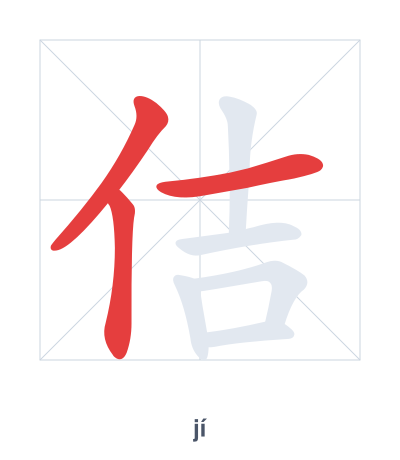
Open Hanzi Writer to see the animated stroke order and practice writing 佶 with real-time feedback.
The character 佶 (jí) is written with 8 strokes. Follow the standard Chinese stroke order: top to bottom, left to right, outside before inside. The radical 亻 is one of its key components.
Practice the correct stroke order with the Hanzi Writer app to see animated stroke-by-stroke guidance with real-time feedback.
佶 means robust; (of writing) difficult to read.
佶 is a phono-semantic compound: the radical 亻 (person) indicates a human trait, and 吉 (jí, 'auspicious') provides the sound. Its original meaning 'robust' likely referred to a strong, sturdy person.
💡 Memory Tip: Imagine a person (亻) with such good luck (吉) that they are incredibly robust and strong, yet their handwriting is so messy it's nearly impossible to read.
这篇文章读起来很佶屈。
zhè piān wén zhāng dú qǐ lái hěn jí qū
This article is difficult and awkward to read.
他的性格很佶烈。
tā de xìng gé hěn jí liè
His personality is very fierce and intense.
他的字写得很佶正。
tā de zì xiě dé hěn jí zhèng
His handwriting is neat and upright.
Open Hanzi Writer to see the animated stroke order and practice writing 佶 with real-time feedback.
✨ Animated stroke order · Handwriting recognition · HSK-graded practice · Free to use
The character 佶 is made of the radical 亻 (person) on the left and 吉 (jí, meaning 'lucky') on the right. The person radical gives it a human connection, while 吉 adds the sound and a sense of strength — together they suggest a person who is robust, or by extension, writing that is 'strong' in a difficult-to-read way.