啄 (zhuó) means "to peck" in Chinese. It has 11 strokes with the radical 口.
Rated 4.2/5 in difficulty (advanced).
Appears in 3+ common words including 啄木鸟 (zhuó mù niǎo), 啄食 (zhuó shí), 啄 (zhuó).
Due to its 11 strokes, Hanzi Writer's error detection shows 啄 requires focused practice — most learners need 10+ attempts for consistent accuracy.
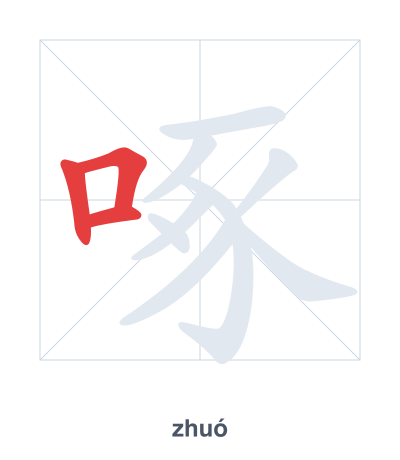
Open Hanzi Writer to see the animated stroke order and practice writing 啄 with real-time feedback.
The character 啄 (zhuó) is written with 11 strokes. Follow the standard Chinese stroke order: top to bottom, left to right, outside before inside. The radical 口 is one of its key components.
Practice the correct stroke order with the Hanzi Writer app to see animated stroke-by-stroke guidance with real-time feedback.
啄 means to peck.
啄 combines the mouth radical 口 with 豖, an ancient pictograph of a pig with a cleft foot. Together, they depict a pig using its snout to root or peck at the ground, a meaning later extended to birds pecking with their beaks.
💡 Memory Tip: Imagine a bird's beak (口) pecking at a pig (豖) that has a dot on its snout — the pig squeals with each peck.
树上有只啄木鸟。
shù shàng yǒu zhǐ zhuó mù niǎo
There is a woodpecker in the tree.
小鸡在啄食。
xiǎo jī zài zhuó shí
The chick is pecking at food.
鸟在啄窗户。
niǎo zài zhuó chuāng hù
The bird is pecking at the window.
Open Hanzi Writer to see the animated stroke order and practice writing 啄 with real-time feedback.
✨ Animated stroke order · Handwriting recognition · HSK-graded practice · Free to use
The character 啄 has the radical 口 (mouth) on the left, showing the action involves the mouth. The right part is a pig (豕) with a dot above, which gives the sound zhuó and visually suggests a bird's beak pecking.