拙 (zhuō) means "Clumsy / awkward" in Chinese. It has 8 strokes with the radical 扌, and is HSK Level 7.
Rated 3.7/5 in difficulty (challenging).
Harder than 26% of HSK Level 7 characters.
Appears in 3+ common words including 笨拙 (bèn zhuō), 拙见 (zhuō jiàn), 拙劣 (zhuō liè).
Due to its 8 strokes, Hanzi Writer's error detection shows 拙 requires focused practice — most learners need 10+ attempts for consistent accuracy.
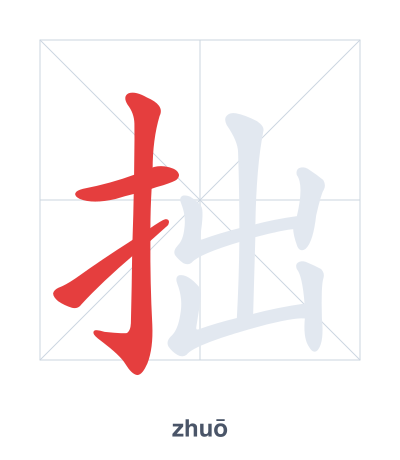
Open Hanzi Writer to see the animated stroke order and practice writing 拙 with real-time feedback.
The character 拙 (zhuō) is written with 8 strokes. Follow the standard Chinese stroke order: top to bottom, left to right, outside before inside. The radical 扌 is one of its key components.
Practice the correct stroke order with the Hanzi Writer app to see animated stroke-by-stroke guidance with real-time feedback.
拙 means Clumsy / awkward.
As an HSK Level 7 character, 拙 is an intermediate-level character.
拙 combines the hand radical 扌 with 出 (meaning 'to go out') as a phonetic component. The idea is of a hand that moves out awkwardly, fumbling or lacking skill.
💡 Memory Tip: Picture a hand (扌) clumsily sticking out (出) in the wrong direction, knocking over everything nearby.
他的动作很笨拙。
tā de dòng zuò hěn bèn zhuō
His movements are very clumsy.
这是我的拙见。
zhè shì wǒ de zhuō jiàn
This is my humble opinion.
这个借口很拙劣。
zhè ge jiè kǒu hěn zhuō liè
This excuse is very clumsy and poor.
Open Hanzi Writer to see the animated stroke order and practice writing 拙 with real-time feedback.
✨ Animated stroke order · Handwriting recognition · HSK-graded practice · Free to use
拙 is composed of the radical 扌 (hand) on the left, and 出 (to go out) on the right. The hand radical suggests an action, while 出 implies moving outward, together they create the image of hands moving awkwardly or clumsily. This combination visually represents the meaning of clumsy or awkward.