躅 (zhú) means "to walk; trace; footprint" in Chinese. It has 20 strokes with the radical 足.
Rated 4.2/5 in difficulty (advanced).
Appears in 3+ common words including 踟躅 (chí zhú), 遗躅 (yí zhú), 躅步 (zhú bù).
Due to its 20 strokes, Hanzi Writer's error detection shows 躅 requires focused practice — most learners need 10+ attempts for consistent accuracy.
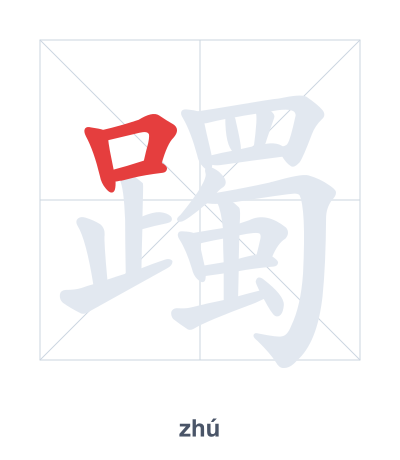
Open Hanzi Writer to see the animated stroke order and practice writing 躅 with real-time feedback.
The character 躅 (zhú) is written with 20 strokes. Follow the standard Chinese stroke order: top to bottom, left to right, outside before inside. The radical 足 is one of its key components.
Practice the correct stroke order with the Hanzi Writer app to see animated stroke-by-stroke guidance with real-time feedback.
躅 means to walk; trace; footprint.
The character 躅 combines the foot radical 足 (foot) with the phonetic component 蜀 (shǔ, a region or insect). The foot indicates the meaning related to walking or footprints, while 蜀 provides the pronunciation. It originally referred to walking carefully or leaving traces, later extending to mean trace or footprint.
💡 Memory Tip: Imagine a huge foot (足) stomping on a worm (蜀) and dragging it, leaving a messy trail (trace) behind.
他在街头独自踟躅。
tā zài jiē tóu dú zì chí zhú
He is loitering alone on the street.
我们要追寻前人的遗躅。
wǒ men yào zhuī xún qián rén de yí zhú
We should follow in the footsteps of our predecessors.
他在林间小路躅步而行。
tā zài lín jiān xiǎo lù zhú bù ér xíng
He is walking slowly along the forest path.
Open Hanzi Writer to see the animated stroke order and practice writing 躅 with real-time feedback.
✨ Animated stroke order · Handwriting recognition · HSK-graded practice · Free to use
The left component is 足 (foot), which gives the character its walking-related meaning. The right component is 蜀, which provides a phonetic clue (though its modern pronunciation is shǔ, not zhú). Together, 躅 means 'to walk' or 'to hesitate,' linking the foot radical to movement.