燥 (zào) means "Dry / Arid" in Chinese. It has 17 strokes with the radical 火, and is HSK Level 7.
Rated 4.2/5 in difficulty (advanced).
Harder than 71% of HSK Level 7 characters.
Appears in 3+ common words including 干燥 (gān zào), 急躁 (jí zào), 燥热 (zào rè).
Due to its 17 strokes, Hanzi Writer's error detection shows 燥 requires focused practice — most learners need 10+ attempts for consistent accuracy.
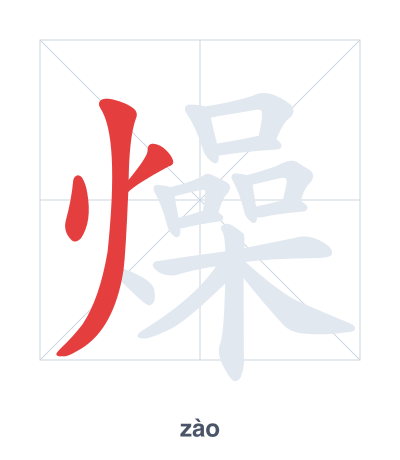
Open Hanzi Writer to see the animated stroke order and practice writing 燥 with real-time feedback.
The character 燥 (zào) is written with 17 strokes. Follow the standard Chinese stroke order: top to bottom, left to right, outside before inside. The radical 火 is one of its key components.
Practice the correct stroke order with the Hanzi Writer app to see animated stroke-by-stroke guidance with real-time feedback.
燥 means Dry / Arid.
As an HSK Level 7 character, 燥 is an intermediate-level character.
燥 is a phono-semantic compound. The left component 火 (fire) signifies heat that causes dryness, while the right component 喿 (zào, meaning 'chirping' or 'noise') provides the pronunciation. Together, the character depicts the concept of being dried out by intense heat.
💡 Memory Tip: Picture a blazing fire (火) beneath a tree (木) where three thirsty mouths (口口口) are gasping for moisture, all parched and dry.
北方的空气很干燥。
běi fāng de kōng qì hěn gān zào
The air in the north is very dry.
他的性格很急躁。
tā de xìng gé hěn jí zào
His personality is very irritable and impatient.
沙漠的气候很燥热。
shā mò de qì hòu hěn zào rè
The desert climate is very hot and dry.
Open Hanzi Writer to see the animated stroke order and practice writing 燥 with real-time feedback.
✨ Animated stroke order · Handwriting recognition · HSK-graded practice · Free to use
燥 is composed of the radical 火 (fire) on the left and the phonetic component 喿 (zào) on the right. The fire radical suggests heat or dryness, while 喿 gives the pronunciation. Together, they create the meaning of something made dry or arid by fire or heat.