咱 (zá/zán) means "we; us (usually inclusive)" in Chinese. It has 9 strokes with the radical 口, and is HSK Level 2.
Rated 3.5/5 in difficulty (challenging).
Harder than 60% of HSK Level 2 characters.
Appears in 3+ common words including 咱们 (zán men), 咱俩 (zán liǎ), 咱家 (zá jiā).
Due to its 9 strokes, Hanzi Writer's error detection shows 咱 requires focused practice — most learners need 10+ attempts for consistent accuracy.
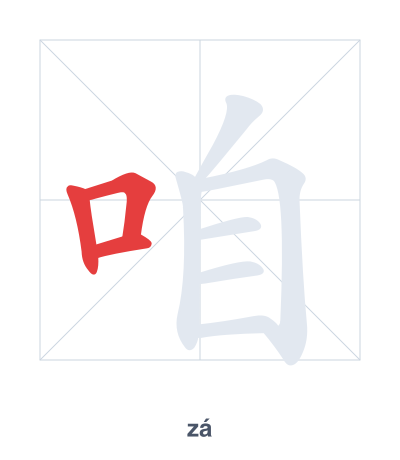
Open Hanzi Writer to see the animated stroke order and practice writing 咱 with real-time feedback.
The character 咱 (zá/zán) is written with 9 strokes. Follow the standard Chinese stroke order: top to bottom, left to right, outside before inside. The radical 口 is one of its key components.
Practice the correct stroke order with the Hanzi Writer app to see animated stroke-by-stroke guidance with real-time feedback.
咱 means we; us (usually inclusive).
This is a polyphonic character with readings: zá, zán.
As an HSK Level 2 character, 咱 is among the first characters beginners learn.
咱 is a compound character combining 口 (mouth) and 自 (self), suggesting 'self speaking' or 'one's own mouth' — a way to include the speaker and listeners together as 'we'. Historically, it evolved as a contraction of the phrase 自家 (zìjiā, 'self's family') in colloquial Chinese during the Yuan dynasty.
💡 Memory Tip: Picture a group huddled around a mouth (口) labeled 'self' (自), all shouting 'We! We!' together.
咱们一起去吧。
zán men yì qǐ qù ba
Let's go together.
咱俩去打球。
zán liǎ qù dǎ qiú
The two of us are going to play ball.
咱家就在前面。
zá jiā jiù zài qián miàn
Our home is just ahead.
Open Hanzi Writer to see the animated stroke order and practice writing 咱 with real-time feedback.
✨ Animated stroke order · Handwriting recognition · HSK-graded practice · Free to use
咱 is made of 口 (mouth) on the left and 自 (self) on the right. The mouth radical hints at spoken language, while self represents the speaker. Together they suggest a group that includes the speaker — 'we' or 'us' — as in speaking for a group that includes yourself.