岳 (yuè) means "High mountain / Wife's parents" in Chinese. It has 8 strokes with the radical 山, and is HSK Level 7.
Rated 3.7/5 in difficulty (challenging).
Harder than 24% of HSK Level 7 characters.
Appears in 3+ common words including 岳父 (yuè fù), 岳母 (yuè mǔ), 五岳 (wǔ yuè).
Due to its 8 strokes, Hanzi Writer's error detection shows 岳 requires focused practice — most learners need 10+ attempts for consistent accuracy.
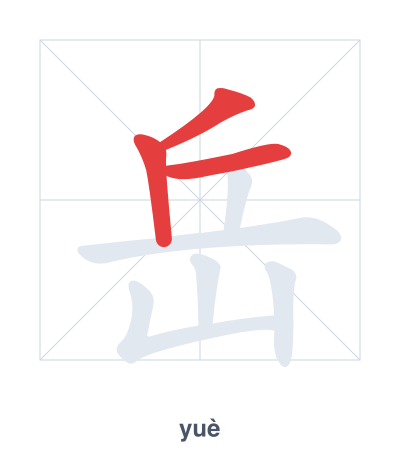
Open Hanzi Writer to see the animated stroke order and practice writing 岳 with real-time feedback.
The character 岳 (yuè) is written with 8 strokes. Follow the standard Chinese stroke order: top to bottom, left to right, outside before inside. The radical 山 is one of its key components.
Practice the correct stroke order with the Hanzi Writer app to see animated stroke-by-stroke guidance with real-time feedback.
岳 means High mountain / Wife's parents.
As an HSK Level 7 character, 岳 is an intermediate-level character.
The character 岳 combines 丘 (hill) above 山 (mountain), originally depicting a mountain that rises above hills, hence a high peak. Its meaning extended to 'wife's parents' (as in 岳父, 岳母) because of the reverence associated with towering mountains. The ancient form shows a hill atop a mountain, emphasizing height.
💡 Memory Tip: Imagine a hill (丘) sitting on top of a mountain (山) — that towering peak is 岳, where your awe-inspiring in-laws live like majestic rulers.
他去机场接岳父。
tā qù jī chǎng jiē yuè fù
He went to the airport to pick up his father-in-law.
岳母对他很好。
yuè mǔ duì tā hěn hǎo
His mother-in-law treats him very well.
中国有五岳名山。
zhōng guó yǒu wǔ yuè míng shān
China has the five famous Great Mountains.
Open Hanzi Writer to see the animated stroke order and practice writing 岳 with real-time feedback.
✨ Animated stroke order · Handwriting recognition · HSK-graded practice · Free to use
The character 岳 is made of two parts: the top part 丘 (meaning 'hill') and the bottom part 山 (meaning 'mountain'). Together they suggest a hill on top of a mountain, which creates the meaning of a 'high mountain'. This same character is also used for 'wife's parents', possibly because they are as respected as a great mountain.