瘐 (yǔ) means "to die of illness or hunger in prison" in Chinese. It has 13 strokes with the radical 疒.
Rated 4.2/5 in difficulty (advanced).
Appears in 3+ common words including 瘐死 (yǔ sǐ), 瘐毙 (yǔ bì), 瘐困 (yǔ kùn).
Due to its 13 strokes, Hanzi Writer's error detection shows 瘐 requires focused practice — most learners need 10+ attempts for consistent accuracy.
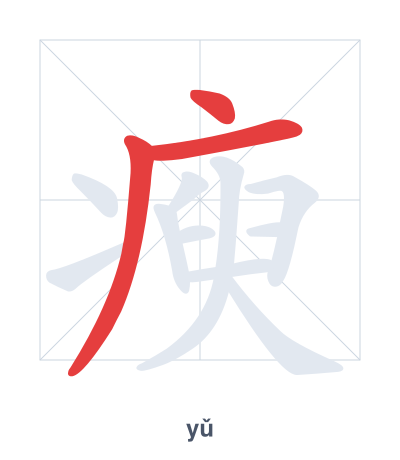
Open Hanzi Writer to see the animated stroke order and practice writing 瘐 with real-time feedback.
The character 瘐 (yǔ) is written with 13 strokes. Follow the standard Chinese stroke order: top to bottom, left to right, outside before inside. The radical 疒 is one of its key components.
Practice the correct stroke order with the Hanzi Writer app to see animated stroke-by-stroke guidance with real-time feedback.
瘐 means to die of illness or hunger in prison.
This compound character combines the sickness radical 疒 with 臾 (yú), a component that in ancient forms may have depicted a person confined or a cage; together, the character visually represents illness or starvation leading to death while imprisoned.
💡 Memory Tip: Picture a sick person (疒) hunched over in a cramped cell (臾 like a bent figure inside a box), slowly starving or dying of disease.
那个犯人瘐死在狱中。
nà ge fàn rén yǔ sǐ zài yù zhōng
That prisoner died of illness in prison.
他在牢里被瘐毙了。
tā zài láo lǐ bèi yǔ bì le
He died of illness in prison.
他感到十分瘐困。
tā gǎn dào shí fēn yǔ kùn
He felt very exhausted and worn out.
Open Hanzi Writer to see the animated stroke order and practice writing 瘐 with real-time feedback.
✨ Animated stroke order · Handwriting recognition · HSK-graded practice · Free to use
The character 瘐 combines the radical 疒 (illness) with the phonetic component 臾 (yú). The radical indicates that the meaning involves sickness, while 臾 provides the pronunciation. Together, they form the idea of dying from disease or hunger while imprisoned.