圉 (yǔ) means "stable / groom / prison" in Chinese. It has 11 strokes with the radical 囗.
Rated 4.2/5 in difficulty (advanced).
Appears in 3+ common words including 圉人 (yǔ rén), 牧圉 (mù yǔ), 圉禁 (yǔ jìn).
Due to its 11 strokes, Hanzi Writer's error detection shows 圉 requires focused practice — most learners need 10+ attempts for consistent accuracy.
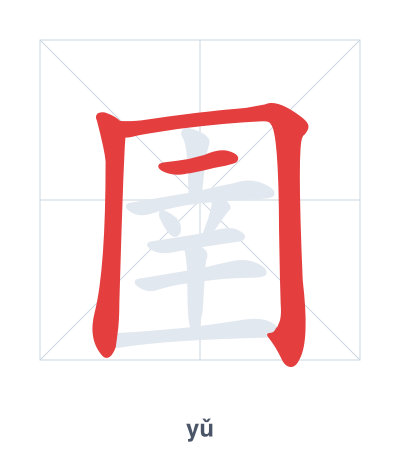
Open Hanzi Writer to see the animated stroke order and practice writing 圉 with real-time feedback.
The character 圉 (yǔ) is written with 11 strokes. Follow the standard Chinese stroke order: top to bottom, left to right, outside before inside. The radical 囗 is one of its key components.
Practice the correct stroke order with the Hanzi Writer app to see animated stroke-by-stroke guidance with real-time feedback.
圉 means stable / groom / prison.
The character 圉 combines the radical 囗, meaning 'enclosure', with 幸, which in its ancient form depicted a device of restraint or handcuffs. Together, they show a person bound inside an enclosure, connecting to meanings like 'prison' or a 'stable' where animals are confined. The sense 'groom' comes from the idea of someone who works within such an enclosure tending to horses.
💡 Memory Tip: Picture a prisoner (幸) trapped inside a square corral (囗), where the groom yells 'Hey, you're not a horse!'
圉人在马厩喂马。
yǔ rén zài mǎ jiù wèi mǎ
The stableman is feeding the horses in the stable.
牧圉在草地上放羊。
mù yǔ zài cǎo dì shàng fàng yáng
The herdsman is herding sheep on the grass.
他被圉禁在房间里。
tā bèi yǔ jìn zài fáng jiān lǐ
He was confined in the room.
Open Hanzi Writer to see the animated stroke order and practice writing 圉 with real-time feedback.
✨ Animated stroke order · Handwriting recognition · HSK-graded practice · Free to use
圉 is made of the radical 囗 (enclosure) on the outside and the character 幸 (originally meaning ‘fortunate’ but here representing restraint) on the inside. Together, the outer box and inner component suggest a confined space where animals or people are held, giving the meanings ‘stable,’ ‘groom,’ or ‘prison.’ The enclosure radical directly connects to the idea of a confined area.