囿 (yòu) means "Enclosure / To limit / To be constrained" in Chinese. It has 9 strokes with the radical 囗.
Rated 4/5 in difficulty (challenging).
Appears in 3+ common words including 囿于 (yòu yú), 园囿 (yuán yòu), 局囿 (jú yòu).
Due to its 9 strokes, Hanzi Writer's error detection shows 囿 requires focused practice — most learners need 10+ attempts for consistent accuracy.
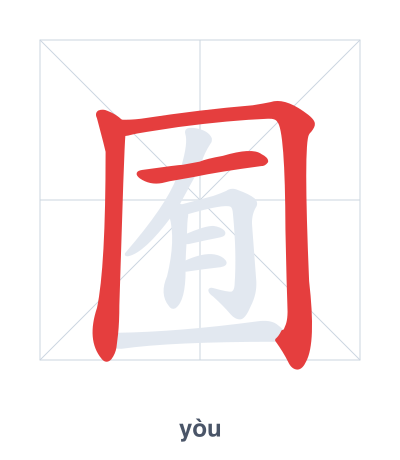
Open Hanzi Writer to see the animated stroke order and practice writing 囿 with real-time feedback.
The character 囿 (yòu) is written with 9 strokes. Follow the standard Chinese stroke order: top to bottom, left to right, outside before inside. The radical 囗 is one of its key components.
Practice the correct stroke order with the Hanzi Writer app to see animated stroke-by-stroke guidance with real-time feedback.
囿 means Enclosure / To limit / To be constrained.
囿 is a compound character: the outer 囗 represents an enclosure or garden, while the inner 有 ('to have') indicates what is contained within. It originally depicted a royal hunting park or animal enclosure, thus conveying the meanings of enclosure, limitation, and constraint.
💡 Memory Tip: Picture a square pen (囗) with a big 'Y' (for yòu) written inside, reminding you that the animal is confined and limited to that space.
别囿于成见。
bié yòu yú chéng jiàn
Don't be limited by prejudice.
这里有一座园囿。
zhè lǐ yǒu yī zuò yuán yòu
There is a garden here.
他的思想被局囿了。
tā de sī xiǎng bèi jú yòu le
His thinking is confined and limited.
Open Hanzi Writer to see the animated stroke order and practice writing 囿 with real-time feedback.
✨ Animated stroke order · Handwriting recognition · HSK-graded practice · Free to use
囿 consists of the radical 囗 (enclosure) surrounding 有 (to have/to exist). This structure represents an enclosed area containing something, which gives the character its core meanings of a physical enclosure or being limited within boundaries.