圃 (pǔ) means "Garden / Orchard" in Chinese. It has 10 strokes with the radical 囗.
Rated 4.2/5 in difficulty (advanced).
Appears in 3+ common words including 花圃 (huā pǔ), 苗圃 (miáo pǔ), 园圃 (yuán pǔ).
Due to its 10 strokes, Hanzi Writer's error detection shows 圃 requires focused practice — most learners need 10+ attempts for consistent accuracy.
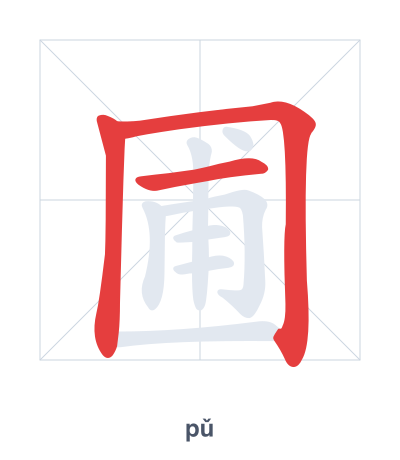
Open Hanzi Writer to see the animated stroke order and practice writing 圃 with real-time feedback.
The character 圃 (pǔ) is written with 10 strokes. Follow the standard Chinese stroke order: top to bottom, left to right, outside before inside. The radical 囗 is one of its key components.
Practice the correct stroke order with the Hanzi Writer app to see animated stroke-by-stroke guidance with real-time feedback.
圃 means Garden / Orchard.
圃 combines the radical 囗 (enclosure) with 甫, which originally depicted a seedling or young plant in a field. The outer square represents a fenced area, while the inner part shows plants growing, together meaning a cultivated garden or orchard.
💡 Memory Tip: Picture a square pen (囗) where a farmer carefully plants a single seedling (甫) to create a small garden.
花圃里开满了花。
huā pǔ lǐ kāi mǎn le huā
The flower nursery is full of blooming flowers.
苗圃里有很多小树。
miáo pǔ lǐ yǒu hěn duō xiǎo shù
There are many small trees in the nursery.
这是一个大园圃。
zhè shì yí gè dà yuán pǔ
This is a large garden.
Open Hanzi Writer to see the animated stroke order and practice writing 圃 with real-time feedback.
✨ Animated stroke order · Handwriting recognition · HSK-graded practice · Free to use
圃 has the radical 囗 (enclosure) on the outside, which represents a fenced area. Inside, the component 甫 (fǔ) originally meant "to plant" or "begin", so together the character suggests a piece of land enclosed for planting — a garden or orchard.