圂 (hùn) means "Pigsty / Latrine" in Chinese. It has 10 strokes with the radical 囗.
Rated 4.2/5 in difficulty (advanced).
Appears in 3+ common words including 圂厕 (hùn cè), 圂圈 (hùn quān), 圂中 (hùn zhōng).
Due to its 10 strokes, Hanzi Writer's error detection shows 圂 requires focused practice — most learners need 10+ attempts for consistent accuracy.
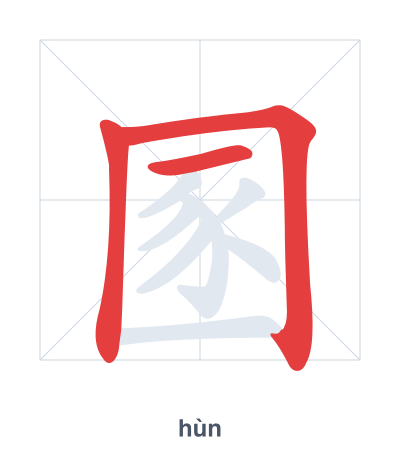
Open Hanzi Writer to see the animated stroke order and practice writing 圂 with real-time feedback.
The character 圂 (hùn) is written with 10 strokes. Follow the standard Chinese stroke order: top to bottom, left to right, outside before inside. The radical 囗 is one of its key components.
Practice the correct stroke order with the Hanzi Writer app to see animated stroke-by-stroke guidance with real-time feedback.
圂 means Pigsty / Latrine.
This character 圂 is a compound of the radical 囗 (enclosure) and 豕 (pig), depicting a pig inside a pen. In ancient China, pigsties often doubled as latrines because pigs consumed human waste, so the same character came to mean both 'pigsty' and 'latrine.'
💡 Memory Tip: Picture a pig (豕) trapped in a square pen (囗) where it eats your poop—a messy pigsty that doubles as a latrine.
圂厕在房子后面。
hùn cè zài fáng zi hòu miàn
The latrine is behind the house.
圂圈里有几头猪。
hùn quān lǐ yǒu jǐ tóu zhū
There are several pigs in the pigpen.
猪在圂中睡觉。
zhū zài hùn zhōng shuì jiào
The pig is sleeping in the pigsty.
Open Hanzi Writer to see the animated stroke order and practice writing 圂 with real-time feedback.
✨ Animated stroke order · Handwriting recognition · HSK-graded practice · Free to use
圂 is made up of the enclosure radical 囗 on the outside and 豕 (pig) on the inside. The 囗 represents a confined space, and a pig inside that space suggests a pigsty. Historically, pigsties were also used as latrines, so the character carries both meanings.