庸 (yōng) means "mediocre or ordinary" in Chinese. It has 11 strokes with the radical 广, and is HSK Level 7.
Rated 4.2/5 in difficulty (advanced).
Harder than 54% of HSK Level 7 characters.
Appears in 3+ common words including 平庸 (píng yōng), 庸医 (yōng yī), 中庸 (zhōng yōng).
Due to its 11 strokes, Hanzi Writer's error detection shows 庸 requires focused practice — most learners need 10+ attempts for consistent accuracy.
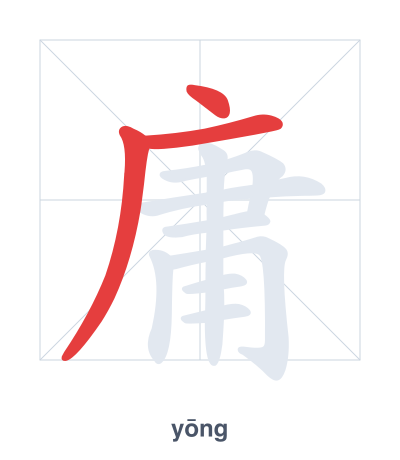
Open Hanzi Writer to see the animated stroke order and practice writing 庸 with real-time feedback.
The character 庸 (yōng) is written with 11 strokes. Follow the standard Chinese stroke order: top to bottom, left to right, outside before inside. The radical 广 is one of its key components.
Practice the correct stroke order with the Hanzi Writer app to see animated stroke-by-stroke guidance with real-time feedback.
庸 means mediocre or ordinary.
As an HSK Level 7 character, 庸 is an intermediate-level character.
庸 originally meant 'to use' or 'employ', depicted as a tool (用) under a shelter (广), symbolizing common daily tasks. Over time, it shifted to mean 'ordinary' or 'mediocre', as things used routinely become unremarkable.
💡 Memory Tip: Picture a shed (广) filled with nothing but plain, boring tools (用) — utterly mediocre.
他过着平庸的生活。
tā guò zhe píng yōng de shēng huó
He lives a mediocre life.
别被那个庸医骗了。
bié bèi nà ge yōng yī piàn le
Don't be fooled by that quack doctor.
他做事讲究中庸之道。
tā zuò shì jiǎng jiū zhōng yōng zhī dào
He follows the Doctrine of the Mean in his actions.
Open Hanzi Writer to see the animated stroke order and practice writing 庸 with real-time feedback.
✨ Animated stroke order · Handwriting recognition · HSK-graded practice · Free to use
庸 combines the radical 广 (roof/shelter) with the component 用 (use) and a simplified form of 庚 (a celestial stem). The roof suggests a covering or protection, while 'use' hints at functionality—together implying something ordinary or commonly used, hence 'mediocre'.