庠 (xiáng) means "Ancient school" in Chinese. It has 9 strokes with the radical 广.
Rated 4/5 in difficulty (challenging).
Appears in 3+ common words including 庠序 (xiáng xù), 入庠 (rù xiáng), 庠生 (xiáng shēng).
Due to its 9 strokes, Hanzi Writer's error detection shows 庠 requires focused practice — most learners need 10+ attempts for consistent accuracy.
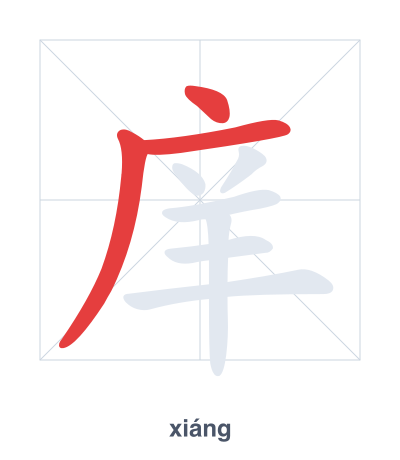
Open Hanzi Writer to see the animated stroke order and practice writing 庠 with real-time feedback.
The character 庠 (xiáng) is written with 9 strokes. Follow the standard Chinese stroke order: top to bottom, left to right, outside before inside. The radical 广 is one of its key components.
Practice the correct stroke order with the Hanzi Writer app to see animated stroke-by-stroke guidance with real-time feedback.
庠 means Ancient school.
The character 庠 combines the radical 广 (shelter/building) with 羊 (sheep). In ancient China, the word originally meant a sheep pen, but was later borrowed to mean a school because both places involve nurturing—schools nourish students just as a pen nourishes sheep.
💡 Memory Tip: Imagine a sheep (羊) sitting under a roof (广) as an ancient teacher lecturing students in a school.
古代学校叫庠序。
gǔ dài xué xiào jiào xiáng xù
Ancient schools were called Xiangxu.
他今年入庠读书。
tā jīn nián rù xiáng dú shū
He started school this year.
他是一名庠生。
tā shì yī míng xiáng shēng
He is a scholar of the ancient local school.
Open Hanzi Writer to see the animated stroke order and practice writing 庠 with real-time feedback.
✨ Animated stroke order · Handwriting recognition · HSK-graded practice · Free to use
庠 combines the radical 广 (a shelter or building) with the component 羊 (sheep). The radical 广 suggests a place, while 羊 may originally have provided a phonetic clue or symbolized a gathering; together they form the concept of an ancient school building.